Question
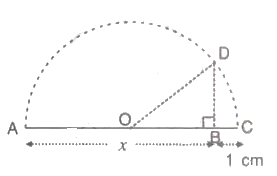
Using the following figure, show that $BD =\sqrt{x}$.
Image

Answer

$ \mathrm{AB}=\mathrm{x}$ and $\mathrm{BC}=1$
$ \mathrm{AC}=\mathrm{AB}+\mathrm{BC}$
$ =\mathrm{x}+1$
diameter$=\mathrm{x}+1$
radius $\mathrm{OA}=\mathrm{OD}=\mathrm{OC}=\mathrm{OB}=\mathrm{OC}-\mathrm{BC}$
$ =\frac{x+1}{2}-1=\frac{x+1-2}{2}=\frac{x-1}{2}$
Using pythagoras in $\triangle \mathrm{BOD}$
$\mathrm{P}^2+\mathrm{B}^2=\mathrm{H}^2$
$ \mathrm{P}^2+\left(\frac{x-1}{2}\right)^2=\left(\frac{x+1}{2}\right)^2$
$ \mathrm{P}^2=\left(\frac{x+1}{2}\right)^2-\left(\frac{x-1}{2}\right)^2$
$ =\frac{(x+1)^2-(x-1)^2}{4}$
$ =\frac{\left(x^2+1+2 x\right)-\left(x^2+1-2 x\right)}{4}$
$\mathrm{P}^2=\frac{4 x}{4}$
$P^2=x$
$\mathrm{P}=\sqrt{x}$

Need a full question paper?

Generate a complete, print-ready paper with questions like this in minutes — across 16+ boards, with answer keys.
Start Generating Free

Similar questions

A kite is flying with a thread 150 m long. If the thread is assumed stretched straight and makes an angle of 60 with the horizontal, find the height of the kite above the ground. (Take $\sqrt{3}=1.73$.)
Find the value of $' y\ '$ if $\sqrt{3}=1.723$.Given your answer correct to $2$ decimal places.
Image
The angles of a triangle formed by $2$ adjacent sides and a diagonal of a parallelogram are in the ratio $1 : 5 : 3$. Calculate the measures of all the angles of the parallelogram.
The list price of a watch is $Rs.4000.$ It is available either at $25\%$ flat discount or at successive discounts of $15\%$ and $12\%. $ Calculate the better offer and the amount paid in the second offer.
A manufacturer makes $800$ straws at a cost of $50$ paise per straw. He fixes the selling price such that if only $640$ straws are sold, he would make a profit of $50\%$ on his outlay. Find his actual profit or loss percent, if he sells $720$ straws.
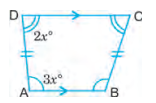
In the given figure, ABCD is an isosceles trapezium in which $\angle CDA =2 x$ and $\angle BAD =3 x$.
Find all the angles of the trapezium.
Image
The denominator of a fraction is $18$ more than the numerator. If $1$ is added to both the numerator and denominator, the value of the fraction equals the value of fraction obtained by adding $8$ to the numerator and $15$ to the denominator. Find the fraction.
In the given figure, $AB = AC$. Show that $AD > AB$.
Image
Observe the given frequency table to answer the following:
Class Interval $20 - 24$ $25 29$ $30 - 34$ $35 - 39$ $40 - 44$ $45 - 49$
Frequency $6$ $12$ $10$ $15$ $9$ $2$
$a$. The true class limits of the fifth class.;$b$. The size of the second class.;$c$. The class boundaries of the fourth class.$d$. The upper and lower limits of the sixth class.$e$. The class mark of the third class.
Image
Case Study I: The union of the set of rational numbers (Q) and irrational numbers (P) form the set of real numbers (R). Rational numbers are the set of numbers which can be written in the form $\frac{a}{b}$ , where a and b are integers and $b \neq 0$. The decimal expansion of a rational number is either terminating or non-terminating repeating. The number which cannot be expressed in the form $\frac{a}{b}$ are called irrational numbers. The decimal expansion of irrational numbers is non-terminating non-repeating.
Based on the above information, answer the following questions:
1. Every rational number is:
(a) a natural number (b) a whole number
(c) an integer (d) a real number
2. Every real number is:
(a) an integer
(b) a rational number
(c) an irrational number
(d) either a rational number or an irrational number.
3. The sum of two irrationals is:
(a) irrational (b) rational
(c) either rational or irrational (d) neither rational nor irrational
4. The product of a rational and an irrational number is:
(a) an irrational number
(b) a rational number
(c) either a rational number or an irrational number
(d) neither a rational number nor an irrational number
5. The number of irrational numbers is:
(a) finite (b) infinite
(c) neither finite nor infinite (d) none of these