Questions

[5 marks sum]

🎯

Test yourself on this topic

12 questions · timed · auto-graded

Question 15 Marks
Show that: $\frac{4-\sqrt{5}}{4+\sqrt{5}}+\frac{2}{5+\sqrt{3}}+\frac{4+\sqrt{5}}{4-\sqrt{5}}+\frac{2}{5-\sqrt{3}}=\frac{52}{11}$
Answer
$\frac{4-\sqrt{5}}{4+\sqrt{5}}+\frac{2}{5+\sqrt{3}}+\frac{4+\sqrt{5}}{4-\sqrt{5}}+\frac{2}{5-\sqrt{3}}$
$=\frac{4-\sqrt{5}}{4+\sqrt{5}} \times \frac{4-\sqrt{5}}{4+\sqrt{5}}+\frac{2}{5+\sqrt{3}} \times \frac{5-\sqrt{3}}{5-\sqrt{3}}+\frac{4+\sqrt{5}}{4-\sqrt{5}} \times \frac{4+\sqrt{5}}{4+\sqrt{5}}+\frac{2}{5-\sqrt{3}} \times \frac{5+\sqrt{3}}{5+\sqrt{3}}$
$=\frac{(4-\sqrt{5})^2}{(4)^2-(\sqrt{5})^2}+\frac{2(5-\sqrt{3})}{(5)^2-(\sqrt{3})^2}+\frac{(4+\sqrt{5})^2}{(4)^2-(\sqrt{5})}+\frac{2(5+\sqrt{3})}{(5)^2-(\sqrt{3})^2}$
$=\frac{16+5-8 \sqrt{5}}{16-5}+\frac{10-2 \sqrt{3}}{25-3}+\frac{16+5+8 \sqrt{5}}{16-5}+\frac{2(5+\sqrt{3})}{25-3}$
$=\frac{21-8 \sqrt{5}}{11}+\frac{10-2 \sqrt{3}}{22}+\frac{21+8 \sqrt{5}}{11}+\frac{\not 2^1(5+\sqrt{3})}{\not 22_{11}}$
$=\frac{21- \not8 \not \sqrt{5}}{11}+\frac{\not 2^1(5-\sqrt{3})}{\not 22_{11}}+\frac{21+8 \sqrt{5}}{11}+\frac{5+\sqrt{\not3}}{11}$
$=\frac{21-\not8 \sqrt{\not5}+5- \sqrt{\not3}+21+\not8 \sqrt{\not5}+5+ \sqrt{\not3}}{11}$
$=\frac{21+5+21+5}{11}$
$=\frac{52}{11}$
View full question & answer
Question 25 Marks
If $x=\sqrt{3}-\sqrt{2}$, find the value of:$(i) x+\frac{1}{x},(ii) x^2+\frac{1}{x^2},(iii)x^3+\frac{1}{x^3},(iv) x^3+\frac{1}{x^3}-3\left(x^2+\frac{1}{x^2}\right)+x+\frac{1}{x}$
Answer
$ x=\sqrt{3}-\sqrt{2}$
$ \frac{1}{x}=\frac{1}{\sqrt{3}-\sqrt{2}} \times \frac{\sqrt{3}+\sqrt{2}}{\sqrt{3}+\sqrt{2}}$
$ \frac{1}{x}=\frac{\sqrt{3}+\sqrt{2}}{(\sqrt{3})^2-(\sqrt{2})^2}$
$ \frac{1}{x}=(\sqrt{3}+\sqrt{2})$
$\text { (i) } x+\frac{1}{x}$
$ =(\sqrt{3}-\sqrt{2})+(\sqrt{3}+\sqrt{2})$
$ =\sqrt{3}-\sqrt{2}+\sqrt{3}+\sqrt{2}$
$ =\sqrt{3}+\sqrt{3}$
$ =2 \sqrt{3}$
$(ii) x^2+\frac{1}{x^2}$
$= \left(x+\frac{1}{x}\right)^2-2 \cdot x \cdot \frac{1}{x} \ldots\left[\mathrm{a}^2+\mathrm{b}^2=(\mathrm{a}+\mathrm{b})^2-2 \mathrm{ab}\right]$
$= (2 \sqrt{3})^2-2$
$= 4 \times 3-2$
$= 10$
$ \text { (iii) } x^3+\frac{1}{x^3}$
$ =\left(x+\frac{1}{x}\right)^3-3 \cdot x \cdot \frac{1}{x}\left(x+\frac{1}{x}\right) \ldots\left[\mathrm{a}^3+\mathrm{b}^3=(\mathrm{a}+\mathrm{b})^3-3 \cdot \mathrm{a} \cdot \mathrm{b}(\mathrm{a}+\mathrm{b})\right]$
$ =(2 \sqrt{3})^3-3 \times(2 \sqrt{3})$
$ =8 \times 3 \sqrt{3}-6 \sqrt{3}$
$ =24 \sqrt{3}-6 \sqrt{3}$
$ =18 \sqrt{3}$
$ \text { (iv) } x^3+\frac{1}{x^3}-3\left(x^2+\frac{1}{x^2}\right)+x+\frac{1}{x}$
$ =18 \sqrt{3}-3(10)+2 \sqrt{3}$
$ =20 \sqrt{3}-30$
$ =10(2 \sqrt{3}-3)$
 
View full question & answer
Question 35 Marks
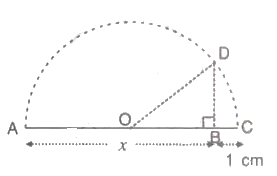
Using the following figure, show that $BD =\sqrt{x}$.
Image
Answer
$ \mathrm{AB}=\mathrm{x}$ and $\mathrm{BC}=1$
$ \mathrm{AC}=\mathrm{AB}+\mathrm{BC}$
$ =\mathrm{x}+1$
diameter$=\mathrm{x}+1$
radius $\mathrm{OA}=\mathrm{OD}=\mathrm{OC}=\mathrm{OB}=\mathrm{OC}-\mathrm{BC}$
$ =\frac{x+1}{2}-1=\frac{x+1-2}{2}=\frac{x-1}{2}$
Using pythagoras in $\triangle \mathrm{BOD}$
$\mathrm{P}^2+\mathrm{B}^2=\mathrm{H}^2$
$ \mathrm{P}^2+\left(\frac{x-1}{2}\right)^2=\left(\frac{x+1}{2}\right)^2$
$ \mathrm{P}^2=\left(\frac{x+1}{2}\right)^2-\left(\frac{x-1}{2}\right)^2$
$ =\frac{(x+1)^2-(x-1)^2}{4}$
$ =\frac{\left(x^2+1+2 x\right)-\left(x^2+1-2 x\right)}{4}$
$\mathrm{P}^2=\frac{4 x}{4}$
$P^2=x$
$\mathrm{P}=\sqrt{x}$
View full question & answer
Question 45 Marks
If $\frac{2+\sqrt{ } 5}{2-\sqrt{ } 5}=x$ and $\frac{2-\sqrt{ } 5}{2+\sqrt{ } 5}=y ;$ find the value of $x^2-y^2$
Answer
$ x =\frac{2+\sqrt{5}}{2-\sqrt{5}}$
$ =\frac{2+\sqrt{5}}{2-\sqrt{5}} \times \frac{2+\sqrt{5}}{2+\sqrt{5}}$
$ =\frac{(2+\sqrt{5})^2}{2^2-(\sqrt{5})^2}$
$ =\frac{4+4 \sqrt{5}+5}{4}-5$
$ =\frac{9+4 \sqrt{5}}{-1}$
$ =-(9-4 \sqrt{5})$
$y =\frac{2-\sqrt{5}}{2+\sqrt{5}}$
$ =\frac{2-\sqrt{5}}{2+\sqrt{5}} \times \frac{2-\sqrt{5}}{2-\sqrt{5}}$
$ =\frac{(2-\sqrt{5})^2}{2^2-(\sqrt{5})^2}$
$ =\frac{4-4 \sqrt{5}+5}{4}-5$
$ =\frac{9-4 \sqrt{5}}{-1}$
$=-(9 +4 \sqrt{5})$
$\therefore x^2-y^2 =(-9-4 \sqrt{5})^2-(-9+4 \sqrt{5})^2$
$ =81+72 \sqrt{5}+80-(81-72 \sqrt{5}+80)$
$ =81+72 \sqrt{5}+80-81+72 \sqrt{5}-80$
$ =144 \sqrt{5}$
View full question & answer
Question 55 Marks
Rationalise the denominator of $: \frac{1}{\sqrt{3 } -\sqrt{2 } +1}$
Answer
$ \frac{1}{\sqrt{3}-\sqrt{2}+1}$
$ =\frac{1}{(\sqrt{3}-\sqrt{2})+1} \times \frac{(\sqrt{3}-\sqrt{2})-1}{(\sqrt{3}-\sqrt{2})-1}$
$ =\frac{\sqrt{3}-\sqrt{2}-1}{(\sqrt{3}-\sqrt{2})^2-(1)^2}$
$ =\frac{\sqrt{3}-\sqrt{2}-1}{(\sqrt{3})^2-2 \sqrt{6}+(\sqrt{2})^2-1}$
$ =\frac{\sqrt{3}-\sqrt{2}-1}{3-2 \sqrt{6}+2-1}$
$ =\frac{\sqrt{3}-\sqrt{2}-1}{4-2 \sqrt{6}}$
$ =\frac{(\sqrt{3}-\sqrt{2})-1}{2(2-\sqrt{6})}$
$ =\frac{\sqrt{3}-\sqrt{2}-1}{2(2-\sqrt{6})} \times \frac{2+\sqrt{6}}{2+\sqrt{6}}$
$ =\frac{2 \sqrt{3}-2 \sqrt{2}-2+\sqrt{18 } -\sqrt{12 } -\sqrt{6}}{2\left[(2)^2-(\sqrt{6})^2\right]}$
$ =\frac{2 \sqrt{3}-2 \sqrt{2}-2+3 \sqrt{2}-2 \sqrt{3}-\sqrt{6}}{2[4-6]}$
$ =\frac{\sqrt{2}-2-\sqrt{6}}{2(-2)}$
$ =\frac{\sqrt{2}-2-\sqrt{6}}{-4}$
$ =\frac{1}{4}(2+\sqrt{6}-\sqrt{2})$
View full question & answer
Question 65 Marks
If $x=5-2 \sqrt{ 6} $, find $x^2+\frac{1}{x^2}$
Answer
Given $x=5-2 \sqrt{6}$
We need to find $x^2+\frac{1}{x^2}$
Since $x=5-2 \sqrt{6}$, we have
$\frac{1}{x}=\frac{1}{5-2 \sqrt{6}}$
$ \Rightarrow \frac{1}{x}=\frac{1}{5-2 \sqrt{6}} \times \frac{5+2 \sqrt{6}}{5+2 \sqrt{6}}$
$ \Rightarrow \frac{1}{x}=\frac{5-2 \sqrt{6}}{(5-2 \sqrt{6})(5+2 \sqrt{6})}$
$ \Rightarrow \frac{1}{x}=\frac{5+2 \sqrt{6}}{5^2-(2 \sqrt{6})^2}$
$ \Rightarrow \frac{1}{x}=\frac{5+2 \sqrt{6}}{25-24}$
$ \Rightarrow \frac{1}{x}=\frac{5+2 \sqrt{6}}{1}$
$\Rightarrow \frac{1}{x}=(5+2 \sqrt{6}) \dots....(1)$
Thus, $\left(x-\frac{1}{x}\right)=(5- \not 2 \sqrt{\not6})-(5+\not 2 \sqrt{\not 6})=10$
$\left(x^2\right)+\left(\frac{1}{x^2}\right)=(-4 \sqrt{6})^2+2$
$ \Rightarrow\left(x^2\right)+\left(\frac{1}{x^2}\right)=96+2$
$ \Rightarrow\left(x^2\right)+\left(\frac{1}{x^2}\right)=98$
View full question & answer
Question 75 Marks
Prove that the following number is irrational: $\sqrt{5 }- 2$
Answer
$\sqrt{5}-2$
Let $\sqrt{5}-2$ be a rational number.
$\Rightarrow \sqrt{5}-2=x$
Squaring on both the sides, we get
$(\sqrt{5}-2)^2=x^2$
$ \Rightarrow 5+4-2 \times 2 \times \sqrt{5}=x^2$
$ \Rightarrow 9-x^2=4 \sqrt{5}$
$ \Rightarrow \sqrt{5}=\frac{9-x^2}{4}$
Here, $\mathrm{x}$ is a rational number.
$\Rightarrow x^2$ is a rational number.
$\Rightarrow 9-x^2$ is a rational number.
$\Rightarrow \frac{9-x^2}{4}$ is also a rational number.
$\Rightarrow \sqrt{2 } =\frac{9-x^2}{4}$ is a rational number
But $\sqrt{2 } $ is an irrational number.
$\Rightarrow \sqrt{5}=\frac{9-x^2}{4}$ is an irrational number.
$\Rightarrow 9-x^2$ is an irrational number.
$\Rightarrow x^2$ is an irrational number.
$\Rightarrow x$ is an irrational number.
But we have assume that $\mathrm{x}$ is a rational number.
$\therefore$ we arrive at a contradiction.
So, our assumption that $\sqrt{5}-2$ is a rational number is wrong.
$\therefore \sqrt{5}-2$ is an irrational number.
View full question & answer
Question 85 Marks
Prove that the following number is irrational: $3 - \sqrt{2}$
Answer
$3-\sqrt{2}$
Let $3-\sqrt{2}$ be a rational number.
$\Rightarrow 3-\sqrt{2 } =x$
Squaring on both the sides, we get
$(3-\sqrt{2})^2=x^2$
$ \Rightarrow 9+2-2 \times 3 \times \sqrt{2 } =x^2$
$ \Rightarrow 11-x^2=6 \sqrt{2 } $
$ \Rightarrow \sqrt{2 } =\frac{11-x^2}{6}$
Here, $x$ is a rational number.
$\Rightarrow x^2$ is a rational number.
$\Rightarrow 11-x^2$ is a rational number.
$\Rightarrow \frac{11-x^2}{6}$ is also a rational number.
$\Rightarrow \sqrt{2}=\frac{11-x^2}{6}$ is a rational number.
But $\sqrt{ 2} $ is an irrational number.
$\Rightarrow \frac{11-x^2}{6}=\sqrt{2}$ is an irrational number.
$\Rightarrow 11-x^2$ is an irrational number.
$\Rightarrow x^2$ is an irrational number.
$\Rightarrow \mathrm{x}$ is an irrational number.
But we have assume that $\mathrm{x}$ is a rational number.
$\therefore$ we arrive at a contradiction.
So, our assumption that $3-\sqrt{ 2} $ is a rational number is wrong.
$\therefore 3-\sqrt{ 2} $ is an irrational number.
View full question & answer
Question 95 Marks
Prove that the following number is irrational: $\sqrt{3} + \sqrt{2}$
Answer
$\sqrt{3}+\sqrt{2}aX$
Let $\sqrt{3}+\sqrt{2}$ be a rational number.
$\Rightarrow \sqrt{3 } +\sqrt{2}=x$
Squaring on both the sides, we get
$(\sqrt{3}+\sqrt{2})^2=x^2$
$ \Rightarrow 3+2+2 \times \sqrt{3 } \times \sqrt{ 2} =x^2$
$ \Rightarrow \mathrm{x}^2-5=2 \sqrt{6 } $
$ \Rightarrow \sqrt{ 6} =\frac{x^2-5}{2}$
Here, $x$ is a rational number.
$\Rightarrow x^2$ is a rational number.
$\Rightarrow x^2-5$ is a rational number.
$\Rightarrow \frac{x^2-5}{2}$ is also a rational number.
But $\sqrt{ 6} $ is an irrational number.
$\Rightarrow \frac{x^2-5}{2}$ is also a irrational number.
$\Rightarrow x^2-5$ is an irrational number.
$\Rightarrow x^2$ is an irrational number.
$\Rightarrow x$ is an irrational number.
But we have assume that $x$ is a rational number.
$\therefore$ we arrive at a contradiction.
So, our assumption that $\sqrt{3 } +\sqrt{2}$ is a rational number is wrong.
$\therefore \sqrt{3}+\sqrt{2}$ is an irrational number.
View full question & answer
Question 105 Marks
Use method of contradiction to show that $\sqrt{3}$ and $\sqrt{5}$ are irrational numbers.
Answer
Let us suppose that $\sqrt{ 3} $ and $\sqrt{5 } $ are rational numbers.
$\therefore \sqrt{ 3} =\frac{a}{b}$ and $\sqrt{5 } =\frac{x}{y}$ (Where $\mathrm{a}, \mathrm{b} \in 7$ and $\left.\mathrm{b}, \mathrm{y} \neq 0 \mathrm{x}, \mathrm{y}\right)$
Squaring both sides,
$3=a^{\prime} b^2, 5=\frac{x^2}{y^2}$
$a3 b^2=a^2, 5 y^2=x^2$
$\Rightarrow \mathrm{a}^2$ and $\mathrm{x}^2$ are odd as $3 \mathrm{\sim b}^2$ and $5 \mathrm{y}^2$ are odd.
$\Rightarrow \mathrm{a}$ and $\mathrm{x}$ are odd $\ldots .(1)$
Let $a=3 c, x=5 z$
$a^2=9 c^2, x^2=25 z^2$
$3 b^2=9 c^2, 5 y^2=25 z^2 \quad ($From equation$)$
$\Rightarrow \mathrm{b}^2=3 \mathrm{c}^2, \mathrm{y}^2=5 \mathrm{z}^2$
$\Rightarrow \mathrm{b}^2$ and $\mathrm{y}^2$ are odd as $3 \mathrm{c}^2$ and $5 \mathrm{z}^2$ are odd.
$\Rightarrow b$ and $y$ are odd $\ldots(2)$
From equation $(1)$ and $(2)$ we get $a, b, x, y$ are odd integers.
i.e., $a, b$, and $x, y$ have common factors $3$ and $5$
this contradicts our assumption that $\frac{a}{b}$ and $\frac{x}{y}$ are rational
i.e, $\mathrm{a}, \mathrm{b}$ and $\mathrm{x}, \mathrm{y}$ do not have any common factors other than.
$\Rightarrow \frac{a}{b}$ and $\frac{x}{y}$ is not rational.
$\Rightarrow \sqrt{ 3} $ and $\sqrt{5}$ and are irrational.

 
View full question & answer
Question 115 Marks
Arrange $\frac{5}{8},-\frac{3}{16},-\frac{1}{4}$ and $\frac{17}{32}$ in descending order of their magnitudes.Also, find the sum of the lowest and largest of these fractions. Express the result obtained as a decimal fraction correct to two decimal places.
Answer
Consider the given numbers : $\frac{5}{8},-\frac{3}{16},-\frac{1}{4}$ and $\frac{17}{32}$
The $\text{LCM}$ of $8,16,4$ and $32$ is $32 .$
Thus, the given numbers are given below:
$ \frac{5}{8},-\frac{3}{16},-\frac{1}{4}$ and $\frac{17}{32}$
$ =\frac{5 \times 4}{8 \times 4},-\frac{3 \times 2}{16 \times 2},-\frac{1 \times 8}{4 \times 8}$ and $\frac{17 \times 1}{32 \times 1}$
$ =\frac{20}{32},-\frac{6}{32},-\frac{8}{32}$ and $\frac{17}{32}$
Thus, the numbers in descending order are shown below:
$\frac{20}{32}, \frac{17}{32},-\frac{6}{32}$ and $-\frac{8}{32}$
Thus, the given numbers in descending order are listed below:
$\frac{5}{8}, \frac{17}{32},-\frac{3}{16}$ and $-\frac{1}{4} \text {. }$
We need to find the sum of the largest and smallest of the above numbers.
Thus, sum $=\frac{5}{8}+\left(-\frac{1}{4}\right)$
$=\frac{5}{8}-\frac{1}{4}$
$ =\frac{5}{8}-\frac{1 \times 2}{4 \times 2}$
$=\frac{5}{8}-\frac{2}{8}$
$=\frac{3}{8}$
We need to express this fraction as a decimal, correct to two decimal places.
Thus, we have $\frac{3}{8}=0.375 \approx 0.38$.
View full question & answer
Question 125 Marks
Arrange $-\frac{5}{7}, \frac{7}{12},-\frac{2}{3}$ and $\frac{11}{18}$ in ascending order of their magnitudes.Also, find the difference between the largest and smallest of these rational numbers. Express this difference as a decimal fraction correct to one decimal place.
Answer
Consider the given number : $-\frac{5}{9}, \frac{7}{12},-\frac{2}{3}$ and $\frac{11}{18}$
The $\text{L.C.M.}$ of $9,12$ and $18 $is $36 .$
Thus, the given numbers are:
$-\frac{5}{9}, \frac{7}{12},-\frac{2}{3}$ and $\frac{11}{18}$
$ =-\frac{5 \times 4}{9 \times 4}, \frac{7 \times 3}{12 \times 3},-\frac{2 \times 12}{3 \times 12} and \frac{11 \times 2}{18 \times 2}$
$ =-\frac{20}{36}, \frac{21}{36},-\frac{24}{36}$ and $\frac{22}{36}$
Thus, the numbers in ascending order are shown below:
$-\frac{24}{36},-\frac{20}{36}, \frac{21}{36}$ and $\frac{22}{36}$
Thus, the given numbers in ascending order are shown below:
$-\frac{2}{3},-\frac{5}{9}, \frac{7}{12}$ and $\frac{11}{18}$
We must find the difference between the largest and smallest of the above numbers.
Thus, difference $=\frac{11}{18}-\left(-\frac{2}{3}\right)$
$=\frac{11}{18}+\frac{2}{3}$
$ =\frac{11}{18}+\frac{2 \times 6}{3 \times 6}$
$ =\frac{11}{18}+\frac{12}{18}$
$ =\frac{11+12}{18}$
$ =\frac{23}{18}$
We need to express this fraction as a decimal, Correct to one decimal place.
Thus, we have $\frac{23}{18}=1.2 \overline{7} \approx 1.3$.
View full question & answer