Question
Using the formula $\overrightarrow{\text{F}}=\text{q}\overrightarrow{\text{v}}\times\overrightarrow{\text{B}}$ and $\text{B}=\frac{\mu_0\text{i}}{2\pi\text{r}},$ show that the SI units of the magnetic field B and the permeability constant $\mu_0$ may be written as N/A-m and $NA^2$ respectively.
Answer

$\overrightarrow{\text{F}}=\text{q}\overrightarrow{\text{v}}\times\overrightarrow{\text{B}}$
$\text{B}=\frac{\text{F}}{\text{qv}}=\frac{\text{F}}{\text{ITv}}=\frac{\text{N}}{\text{A.sec}/\text{sec}.}=\frac{\text{N}}{\text{A-m}}$
$\text{B}=\frac{\mu_0\text{I}}{2\pi\text{r}}$
$\mu_0=\frac{2\pi\text{rB}}{\text{I}}=\frac{\text{m}\times\text{N}}{\text{A-m}\times\text{A}}=\frac{\text{N}}{\text{A}^2}$

Need a full question paper?

Generate a complete, print-ready paper with questions like this in minutes — across 16+ boards, with answer keys.

Start Generating Free

Similar questions

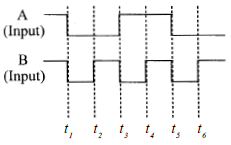
The given inputs A, B are fed to a 2-input NAND gate. Draw the output wave form of the gate.
An object is placed at the principal focus of a concave lens of focal length f. Where will its image be formed?
$\frac{1}{\text{f}}=\frac{1}{\text{v}}-\frac{1}{\text{u}}$
$\Rightarrow\frac{1}{\text{v}}=\frac{1}{\text{f}}+\frac{1}{\text{u}}$
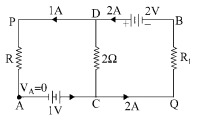
In the given figure, point A is at zero potential. Use Kirchhoff's rules to find out the potential at B.
Image
A neutron having kinetic energy 12.5eV collides with a hydrogen atom at rest. Nelgect the difference in mass between the neutron and the hydrogen atom and assume that the neutron does not leave its line of motion. Find the possible kinetic energies of the neutron after the event.
Answer the following question:
In viewing through a magnifying glass, one usually positions one’s eyes very close to the lens. Does angular magnification change if the eye is moved back?
What will be the effect on induced charge and induced current when change in magnetic flux associated with it is either done with increased rate or decreased rate?
The current in a discharging LR circuit is given by $\text{i}=\text{i}_0\text{e}^{\frac{-\text{t}}{\tau}}$ where $\tau$ is the time constant of the circuit. Calculate the rms current for the period $\text{t}=0$ to $\text{t}=\tau.$
Explain $n$-type and $p$-type semiconductors on the basis of band theory.
What is mass defect? Explain binding energy of the nucleus and the binding energy per nucleon.
$\#\#\#$ Explain binding energy of nucleus.
Verify that the units weber and volt-second are the same.