Question
Using the formula for the radius of $n ^{\text {th }}$ orbit $r_n=\frac{n^2 h^2 \varepsilon_0}{\pi m e^2}$ derive an expression for the total energy of electron in $n^{\text {th }}$ Bohr's orbit.

Answer

$\rightarrow$ From Bohr's second postulate, the formula for the radius of $n^{\text {th }}$ orbit for hydrogen atom is.
$r_n=\frac{n^2 h^2 \varepsilon_0}{\pi m e^2}$
$\rightarrow$ The total energy of the electron in the stationary states of the hydrogen atom is
$E _n=-\frac{1}{8 \pi \varepsilon_0} \frac{e^2}{r_n}$
$\rightarrow$ Using equation $(1)$ and equation $(2)$
$E _n=-\frac{1}{8 \pi \varepsilon_0} \frac{e^2}{\left(\frac{ n ^2 h^2 \kappa_0}{\pi m e^2}\right)}$
$\therefore E _n=-\frac{m e^4}{8 \varepsilon_0{ }^2 n^2 h^2}$
$\rightarrow$ Substituting $m=9.1 \times 10^{-31} \ kg$
$
e=1.6 \times 10^{-19} C$
$\varepsilon_0=8.85 \times 10^{-12} \frac{ C ^2}{ Nm ^2}$
$h=6.625 \times 10^{-34} Js
$
$\rightarrow$ Simplifying equation,
$E _n=-\frac{2.18 \times 10^{-18}}{n^2} J$
$\rightarrow$ Atomic energies are often expressed in electron volts $(e V)$.
$
\therefore E _n=-\frac{2.18 \times 10^{-18}}{n^2 \times 1.6 \times 10^{-19}} eV$
$\therefore E _n=-\frac{13.6}{n^2} eV
$
$\rightarrow$ The negative sign of the total energy of an electron moving in an orbit means that the electron is bound with the nucleus.
$\rightarrow$ Thus, energy will be required to remove the electron from the hydrogen atom to a distance infinitely far away from its nucleus.

Need a full question paper?

Generate a complete, print-ready paper with questions like this in minutes — across 16+ boards, with answer keys.
Start Generating Free

Similar questions

A particle executes simple harmonic motion with an amplitude of 10cm. At what distance from the mean position are the kinetic and potential energies equal?
A boy standing on a long railroad car throws a ball straight upwards. The car is moving on the horizontal road with an acceleration of $1m/s^2$ and the projection velocity in the vertical direction is 9.8m/s. How far behind the boy will the ball fall on the car?
Two heating coils, one of fine wire and other of thick wire, made of the same material and of the same length are connected one by one to a source of electricity. Which coil will produce heat at a greater rate?
State and explain Lenz's law
A circular coil of $25$ turns and radius $6.0 \ cm,$ carrying a current of $10 A,$ is suspended vertically in a uniform magnetic field of magnitude $1.2 T.$ The field lines run horizontally in the plane of the coil. Calculate the force and the torque on the coil due to the magnetic field. In which direction should a balancing torque be applied to prevent the coil from turning?
Write down the expression (equation) to find the distance of $n^{\text {th }}$ bright fringe and $n^{\text {th }}$ dark fringe from the central maximum.
What is the acceleration due to gravity on the top of Mount Everest? Mount Everest is the highest mountain peak of the world at the height of 8848m. The value at sea level is $9.80m/s^2$.
Two transparent slabs having equal thickness but different refractive indices $\mu_1$ and $\mu_2$ are pasted side by side to form a composite slab. This slab is placed just after the double slit in a Young's experiment so that the light from one slit goes through one material and the light from the other slit goes through the other material. What should be the minimum thickness of the slab so that there is a minimum at the point $P_0$ which is equidistant from the slits?
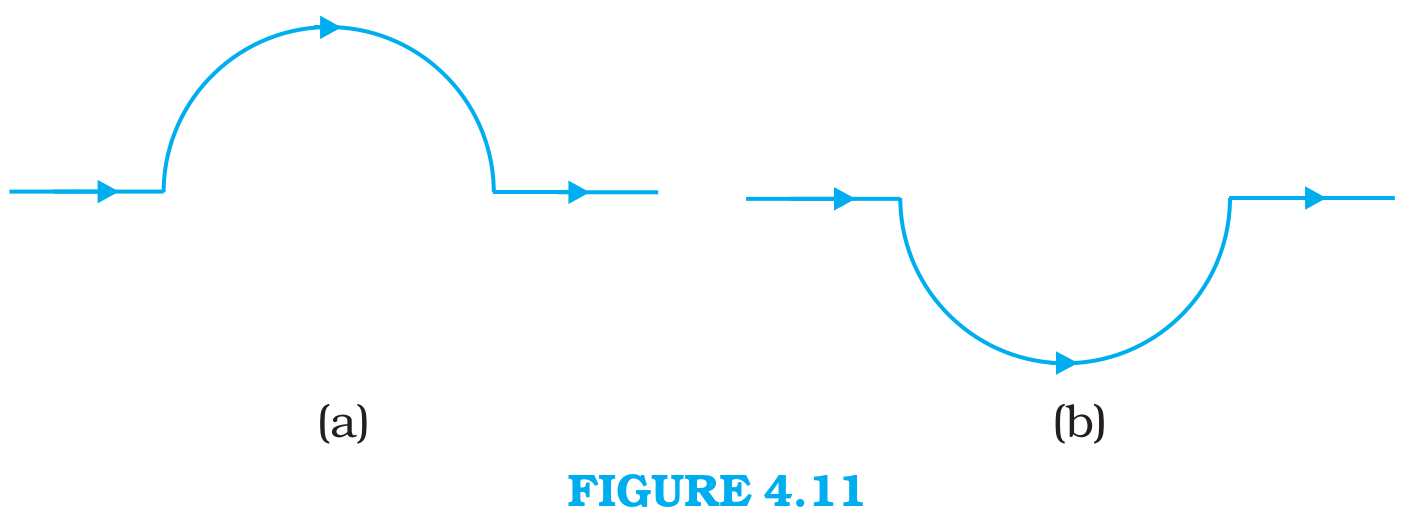
A straight wire carrying a current of $12 A$ is bent into a semi-circular arc of radius $2.0 cm$ as shown in Fig. 4.11 (a). Consider the magnetic field $B$ at the centre of the arc. (a) What is the magnetic field due to the straight segments? (b) In what way the contribution to $B$ from the semicircle differs from that of a circular loop and in what way does it resemble? (c) Would your answer be different if the wire were bent into a semi-circular arc of the same radius but in the opposite way as shown in Fig. 4.11(b)?
Image
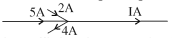
Write Kirchhoff's junction rule. Write the magnitude of current $I$ in the given figure.
Image