Maharashtra BoardEnglish MediumSTD 11 SciencePhysicsMathematical Methods3 Marks
Question
Using triangle law of vector addition, explain the process of adding two vectors which are not lying in a straight line.
✓
Answer
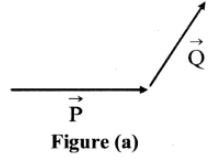
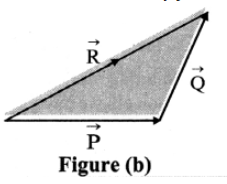
i. Two vectors in magnitude and direction are drawn in a plane as shown in figure (a) Let these vectors be $\overrightarrow{ P }$ and $\overrightarrow{ Q }$ ii. Join the tail of $\vec{Q}$ to head of $\vec{P}$ in the given direction. The resultant vector will be the line which is obtained by joining tail of $\vec{P}$ to head of $\vec{Q}$ as shown in figure (b). iii. If $\vec{R}$ is the resultant vector of $\vec{P}$ and $\vec{Q}$ then using triangle law of vector addition, we have, $\vec{R}=\overrightarrow{ P }+\overrightarrow{ Q }$
Need a full question paper?
Generate a complete, print-ready paper with questions like this in minutes — across 16+ boards, with answer keys.