Question
Using various resources such as your school Library or the internet and discussions with your teacher, trace the evolutionary stages of any one animal say horse.
Answer

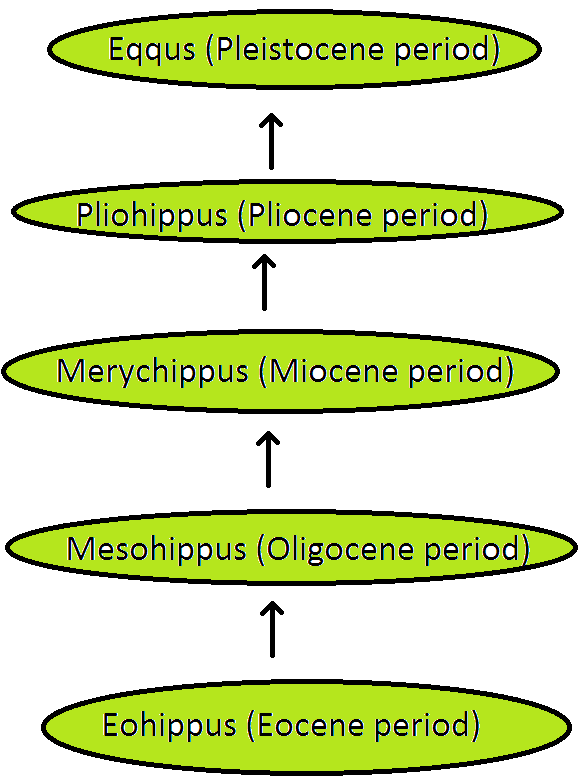
The evolution of horse started with Eohippus during Eocene period.
It involved the following evolutionary stages:
  • Gradual increase in body size.
  • Elongation of head and neck region.
  • Increase in the length of limbs and feet.
  • Gradual reduction of lateral digits.
  • Enlargement of third functional toe.
  • Strengthening of the back.
  • Development of brain and sensory organsn.
  • Crease in the complexity of teeth for feeding on grass.
The evolution of horse is represented as,

  1. Eohippus: It had a short head and neck. It had four functional toes and a splint of 1 and 5 on each hind limb and a splint of 1 and 3 in each forelimb. The molars were short crowned that were adapted for grinding the plant diet.
  2. Mesohippus: It was slightly taller than Eohippus. It had three toes in each foot.
  3. Merychippus: It had the size of approximately 100 cm. Although it still had three toes in each foot, but it could run on one toe. The side toe did not touch the ground. The molars were adapted for chewing the grass.​​​​​​​
  4. Pliohippus: It resembled the modern horse and was around 108 cm tall. It had a single functional toe with splint of 2nd and 4th in each limb.​​​​​​​
  5. Equus: Pliohippus gave rise to Equus or the modern horse with one toe in each foot. They have incisors for cutting grass and molars for grinding food.​​​​​​​

Need a full question paper?

Generate a complete, print-ready paper with questions like this in minutes — across 16+ boards, with answer keys.

Start Generating Free

Similar questions

A true breeding pea plant homozygous for axial violet flowers is crossed with another pea plant with terminal white flowers (aavv).
What would be the phenotype and genotype of F1 and F2 generations?
(a) Draw a sectional view of human ovary and label primary follicle, tertiary follicle, Graafian follicle and corpus luteum in it.
(b) Name the gonadotropins and explain their role in oogenesis and release of ova.
What is the major advantage of producing plants by micropropagation?
Define an operon. Giving an example, explain an Inducible operon.
  1. Explain the differences and similarities between hydrarch and xerarch successions of plants.
  2. Mention the role of living organisms in the phosphorus cycle.
What is somatic hybridisation? Explain different steps involved in the process. Give two importance of somatic hybridisation.
Ramesh is a small scale farmer and holds 2.5 acres of land. He would like to increase the yield in his farm. Rahul, a student of MSc. (Agriculture) advised him to go to the agricultural department centre of his locality to get biofertilisers according to the variety of the crop. He also suggested Ramesh to stop the use of chemical fertilisers.
  1. Explain the term biofertilisers.
  2. Name the biofertiliser that is used mostly in paddy fields.
  3. What are the values shown by Rahul?
Mention three applications and future challenges of human genome project.
Describe the nature of inheritance of the ABO type of blood group in humans. In which ways does this inheritance differ from that of height of the plant in garden pea?
No evidence was found on a crime scene, other than only a few hair strands. The inspector wants to proceed for DNA fingerprinting, but the amount of DNA is very less.
  1. In your opinion what could be the solution to this problem?
  2. Write the basic steps of this technique.
  3. Name the scientist who developed this technique.
  4. What values shown by the inspector?