Question
Using various resources such as your school Library or the internet and discussions with your teacher, trace the evolutionary stages of any one animal say horse.
Answer

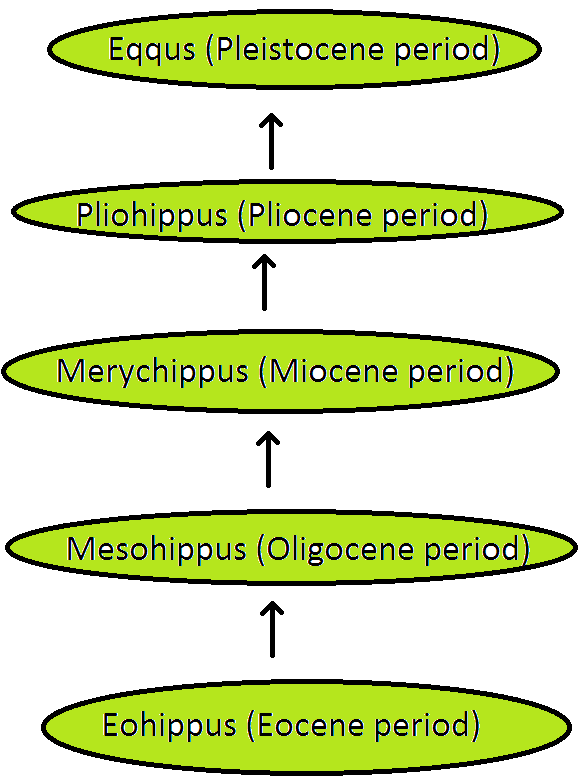
The evolution of horse started with Eohippus during Eocene period.
It involved the following evolutionary stages:
  • Gradual increase in body size.
  • Elongation of head and neck region.
  • Increase in the length of limbs and feet.
  • Gradual reduction of lateral digits.
  • Enlargement of third functional toe.
  • Strengthening of the back.
  • Development of brain and sensory organsn.
  • Crease in the complexity of teeth for feeding on grass.
The evolution of horse is represented as,
  1. Eohippus: It had a short head and neck. It had four functional toes and a splint of 1 and 5 on each hind limb and a splint of 1 and 3 in each forelimb. The molars were short crowned that were adapted for grinding the plant diet.
  2. Mesohippus: It was slightly taller than Eohippus. It had three toes in each foot.
  3. Merychippus: It had the size of approximately 100 cm. Although it still had three toes in each foot, but it could run on one toe. The side toe did not touch the ground. The molars were adapted for chewing the grass.
  4. Pliohippus: It resembled the modern horse and was around 108 cm tall. It had a single functional toe with splint of $2^{nd}$ and $4^{th}$ in each limb.​​​​​​​
  5. Equus: Pliohippus gave rise to Equus or the modern horse with one toe in each foot. They have incisors for cutting grass and molars for grinding food.​​​​​​​

Need a full question paper?

Generate a complete, print-ready paper with questions like this in minutes — across 16+ boards, with answer keys.

Start Generating Free

Similar questions

Read the following and answer any four questions from (i) to (v) given below:
Crown gall is a neoplastic disease of most dicotyledonous plants and is caused by the soil bacterium Agrobacterium tumefaciens. A large extra chromosomal plasmid in these bacteria was found to be responsible for this disease. The plasmid is known as Ti plasmid. Bacteria free crown gall cells can be cultured in the absence of phytohormones. Ti plasmid is widely used in genetic engineering to deliver the desirable genes. The part of Ti plasmid transferred into plant cell DNA is called T-DNA. T-DNA with desired DNA segment is inserted into the chromosome of the host plant where it produces copies of itself.
  1. Which of the following is the full full of T-DNA?
  1. Transfer DNA.
  2. Tumour inducing DNA.
  3. Transgenic DNA.
  4. None of these.
  1. Ti plasmid cannot infect and develop crown gall in,
  1. Tomato.
  2. Maize.
  3. Soybean.
  4. sunflower.
  1. While making transgenic plant, T-DNA is inserted into the host cell, it is then:
  1. Integrated into the target host genome.
  2. Lie independent of the host genome.
  3. Rupture the host cell wall.
  4. Produce oncogenic factors in the host.
  1. Agrobacterium mediated gene transfer in plants:
  1. Allows relatively large segment of DNA.
  2. Transfer of DNA with defined ends and minimal rearrangement.
  3. High quality and fertility in transgenic plants.
  4. All of these.
  1. Assertion: In Agrobacterium mediated gene transfer in plants, transgenic plants do not develop tumors.
Reason: In T-DNA tumor producing genes are deleted during the process of gene transfer.
  1. Both assertion and reason are true and reason is the correct explanation of assertion.
  2. Both assertion and reason are true but reason is not the correct explanation of assertion.
  3. Assertion is true but reason is false.
  4. Both assertion and reason are false.
  1. Explain taking one example of vertebrates anatomy that evolution of life has occurred on earth.
  2. 'Nature selects for fittest.' Explain with suitable examples.
What is meant by immunity? What are the four barriers to innate immunity? Explain . Draw a labelled diagram of the structure of an antibody molecule.
A pregnant human female was advised to undergo M.T.P. It was diagnosed by her doctor that the foetus she is carrying has developed from a zygote formed by an XX egg fertilised by Y–carrying sperms. Why was she advised to undergo M.T.P.?
The following is the illustration of the sequence of ovarian events (a – i) in a human female.
Explain the changes that occur in the uterus simultaneously in anticipation.
The following are some well-known abbreviations, which have been used in this chapter. Expand each one to its full form:
  1. MALT.
  2. CMI.
  3. AIDS.
  4. NACO.
  5. HIV.
For question 1-4, use this key:Key-
  1. Ecology.
  2. Population.
  3. Community.
  4. Ecosystem.
  1. A community plus its physical environment.
  2. Study of the interactions of organisms with each other and with the physical environment.
  3. All populations that are found in a particular area.
  4. All members of the same species that inhabit a particular area.
Which element is responsible for causing soil salinity? At what concentration does the soil become saline?
Although sexual reproduction is a long drawn, energy-intensive complex form of reproduction, many groups of organisms in Kingdom Animalia and Plantae prefer this mode of reproduction. Give atleast three reasons for this.
Can you think of a scientific explanation, besides analogy used by Paul Ehrlich, for the direct relationship between diversity and stability of an ecosystem?