MCQ
$UV$ light of $4.13 \ eV$ is incident on a photosensitive metal surface having work function $3.13 \ eV .$ The maximum kinetic energy of ejected photoelectrons will be $:$
  • A
    4.13 Ev
  • B
    1 eV
  • C
    3.13 eV
  • D
    7.26 eV

Answer

$ E _{\text {photon }}=\text { (work function) }+ K \cdot E _{\max }$
$\therefore 4 \cdot 13=3 \cdot 13+ K \cdot E _{\max }$
$\therefore K \cdot E _{\max }=1 eV $

Need a full question paper?

Generate a complete, print-ready paper with questions like this in minutes — across 16+ boards, with answer keys.
Start Generating Free

Similar questions

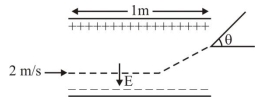
A uniform electric field $E =(8\,m / e ) V / m$ is created between two parallel plates of length $1 m$ as shown in figure, (where $m =$ mass of electron and $e=$ charge of electron). An electron enters the field symmetrically between the plates with a speed of $2\,m / s$. The angle of the deviation $(\theta)$ of the path of the electron as it comes out of the field will be........
Monochromatic light of frequency $6.0 \times 10^{14}\,\, Hz$ is produced by a laser. The power emitted is $2 \times 10^{-3}\,\, W.$ The number of photons emitted, on the average, by the source per second is
A simple pendulum is suspended in a lift which is going up with an acceleration $5\ m/s^2$. An electric  field of magnitude $5 \ N/C$ and directed vertically upward is also present in the lift. The charge of the bob is $1\ mC$ and mass is $1\ mg$. Taking $g = \pi^2$ and length of the simple pendulum $1\ m$, the time period of the simple pendulum is ......$s$
The $x$ - $t$ equation is given as $x=2 t+1$ The corresponding $v-t$ graph is
In the following nuclear rection, $D \stackrel{\alpha}{\longrightarrow} D _{1} \stackrel{\beta-}{\longrightarrow} D _{2} \stackrel{\alpha}{\longrightarrow} D _{3} \stackrel{\gamma}{\longrightarrow} D _{4}$ Mass number of $D$ is $182$ and atomic number is $74$ . Mass number and atomic number of $D _{4}$ respectively will be
The work done in which of the following processes is zero
The current in a wire varies with time according to relation $I = 4 + 2t$. The quantity of charge which has passed through a crosssectionn of the wire during the time $t = 2\, s$ to $t = 6\, s$ will be .............. $\mathrm{C}$
A charge of magnitude $3e$ and mass $2m$ is moving in an electric field $\overrightarrow E .$ The acceleration imparted to the charge is
A long solenoid of $50\, cm$ length having $100$ turns carries a current of $2.5$ $A.$ The magnetic field at the centre of the solenold is $...... \times 10^{-5}\;T$

$\left(\mu_{0}=4 \pi \times 10^{-7}\, T\, m\, A ^{-1}\right)$
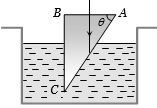
A glass prism $(\mu = 1.5$) is dipped in water $(_a\mu_w = 4/3)$ as shown in figure. $A$ light ray is incident normally on the surface $AB$. It reaches the surface $BC$ after totally reflected, if