$V-i$ graphs for parallel and series combination of two identical resistors are as shown in figure. Which graph represents parallel combination
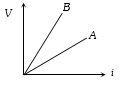
Easy


Download our appand get started for free
Experience the future of education. Simply download our apps or reach out to us for more information. Let's shape the future of learning together!No signup needed.*
Similar Questions
- 1A cell of internal resistance $1.5\,\Omega $ and of $e.m.f.$ $1.5\, volt$ balances $500\, cm$ on a potentiometer wire. If a wire of $15\,\Omega $ is connected between the balance point and the cell, then the balance point will shiftView Solution
- 2Two coils require $20$ minutes and $60$ minutes respectively to produce same amount of heat energy when connected separately to the same source. If they are connected in parallel arrangement to the same source; the time required to produce same amount of heat by the combination of coils, will be________ $min$View Solution
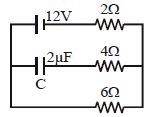
- 3Charge on the capacitor in the given circuit in steady state condition is :- ............... $\mu C$View Solution
- 4In $a$ wire of cross-section radius $r$, free electrons travel with drift velocity $v$ when a current $I$ flows through the wire. What is the current in another wire of half the radius and of the same material when the drift velocity is $2v$?View Solution
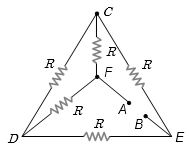
- 5Five equal resistances each of resistance $R$ are connected as shown in the figure. A battery of $V\, volts$ is connected between $A$ and $B$. The current flowing in $AFCEB$ will beView Solution
- 6Resistance of tungsten wire at $150\,^oC$ is $133\,\Omega $. Its resistance temperature coefficient is $0.0045\,^oC$. The resistance of this wire at $500\,^oC$ will be .............. $\Omega$View Solution
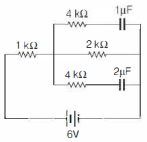
- 7What are the charges stored in the $1 \,\mu F$ and $2 \,\mu F$ capacitors in the circuit below, once the currents become steady?View Solution
- 8If a wire is stretched to make it $0.1 \%$ longer, its resistance willView Solution
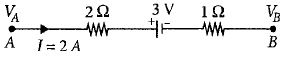
- 9The potential difference $(V_A - V_B)$ between the points $A$ and $B$ in the given figure is ............ $V$View Solution
- 10$A$ uniform copper wire carries a current $i$ amperes and has $p$ carriers per meter$^3$. The length of the wire is $\lambda$ meters and its cross-section area is $s$ meter $^2$. If the charge on a carrier is $q$ coulombs, the drift velocity in $ms^{-1}$ is given byView Solution