MCQ
$V\, = \,K\,{\left( {\frac{P}{T}} \right)^{0.33}}$ where $k$ is constant. It is an,
  • A
    isothermal process
  • B
    adiabatic process
  • isochoric process
  • D
    isobaric process

Answer

Correct option: C.
isochoric process
c
$V\, = \,K\,{\left( {\frac{{nRT}}{{VT}}} \right)^{0.33}}$

$V^{1.33} =$ constan

$V =$ constant

Need a full question paper?

Generate a complete, print-ready paper with questions like this in minutes — across 16+ boards, with answer keys.
Start Generating Free

Similar questions

The area of the acceleration-displacement curve of a body gives
An ice cube at temperature $-20^o C$ is kept in a room at temperature $20^o C$. The variation of temperature of the body with time is given by
If $Y, K$ and $\eta$ are the values of Young's modulus, bulk modulus and modulus of rigidity of any material respectively. Choose the correct relation for these parameters.
A sound source is moving towards a stationary observer with $1/10$ of the speed of sound. The ratio of apparent to real frequency is
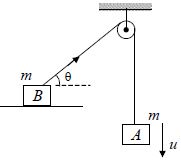
Two equal masses $A$ and $B$ are arranged as shown in the figure. Pulley and string are ideal and there is no friction. Block $A$ has a speed $u$ in the downward direction. The speed of the block $B$ is :-
One mole of a gas obeying the equation of state $P(V-b)=R T$ is made to expand from a state with coordinates $\left(P_{1}, V_{1}\right)$ to a state with $\left(P_{2}, V_{2}\right)$ along a process that is depicted by a straight line on a $P-V$ diagram. Then, the work done is given by
Motion of a ball bearing inside a smooth curved bowl, when released from a point slightly above the lower point is:
The length, breadth and thickness of a strip are $(10.0 \pm 0.1)\; cm ,(1.00 \pm 0.01) \;cm$ and $(0.100 \pm 0.001)\; cm$ respectively. The most probable error in its volume will be?
If the buoyant force $F$ acting on an object depends on its volume $V$ immersed in a liquid, the density $\rho$ of the liquid and the acceleration due to gravity $g$. The correct expression for $F$ can be
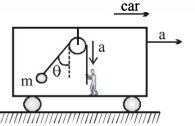
A bob is hanging over a pulley inside a car through, a string. The second end of the string is in the hand of a person standing in the car. The car is moving with constant acceleration ' $a$ ' directed horizontally as shown in figure. Other end of the string is pulled with constant acceleration ' $a$ ' vertically. The tension in the string is equal to-