MCQ
Variable valency is shown by
- ATypical elements
- BNormal elements
- ✓Transition elements
- DNone of these
Generate a complete, print-ready paper with questions like this in minutes — across 16+ boards, with answer keys.
| List $I$ (Coordination entity) | List $II$ (Wavelength of light absorbed in $nm$) |
| $A$ ${\left[ CoCl \left( NH _3\right)_5\right]^{2+}}$ | $I$ $310$ |
| $B$ ${\left[ Co \left( NH _3\right)_6\right]^{3+}}$ | $II$ $475$ |
| $C$ ${\left[ Co ( CN )_6\right]^{3-}}$ | $III$ $535$ |
| $D$ ${\left[ Cu \left( H _2 O \right)_4\right]^{2+}}$ | $IV$ $600$ |
Choose the correct answer from the options given below
$0.48 + \log \left\{ { - \frac{{d[A]}}{{dt}}} \right\} = \log \left\{ { + \frac{{d[B]}}{{dt}}} \right\} + 0.7$
Then, $x : y$ is
$(A)$ ${X}$ is a reducing sugar and ${Y}$ is a non-reducing sugar
$(B)$ ${X}$ is a non-reducing sugar and ${Y}$ is a reducing sugar
$(C)$ The glucosidic linkages in ${X}$ and ${Y}$ are $\alpha$ and $\beta$, respectively
$(D)$ The glucosidic linkages in ${X}$ and ${Y}$ are $\beta$ and $\alpha$, respectively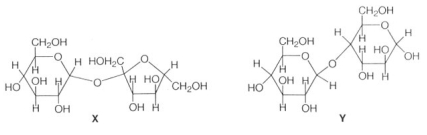
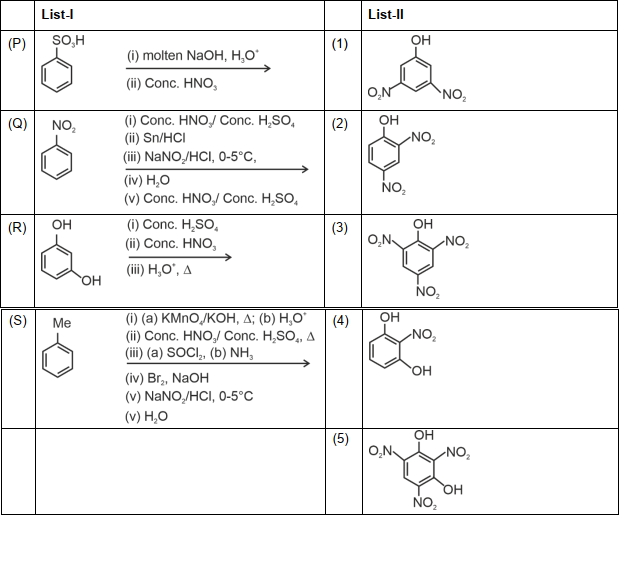
| List$-II$ | List$-II$ |
| $(a)$ ${PCl}_{5}$ | $(i)$ Square pyramidal |
| $(b)$ ${SF}_{6}$ | $(ii)$ Trigonal planar |
| $(c)$ ${BrF}_{5}$ | $(iii)$ Octahedral |
| $(d)$ ${BF}_{3}$ | $(iv)$ Trigonal bipyramidal |
Choose the correct answer from the options given below.
Number of moles of $NaOH $ used in above Hoffmann bromamide reaction is