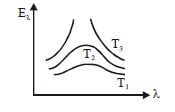
Variation of radiant energy emitted by sun, filament of tungsten lamp and welding arc as a function of its wavelength is shown in figure. Which of the following option is the correct match?
Medium
Download our app for free and get started
In accordance with Wien's displacement law

Download our appand get started for free
Experience the future of education. Simply download our apps or reach out to us for more information. Let's shape the future of learning together!No signup needed.*
Similar Questions
- 1The rate of loss of heat from a body cooling under conditions of forced convection is proportional to its $(A)$ heat capacity $(B)$ surface area $(C)$ absolute temperature $(D)$ excess of temperature over that of surrounding : state ifView Solution
- 2Star $A$ has radius $ r$ surface temperature $T$ while star $B$ has radius $4r$ and surface temperature $T/2$ . The ratio of the power of two starts, $P_A : P_B$ isView Solution
- 3Heat is flowing through two cylindrical rods of the same material. The diameters of the rods are in the ratio $1 : 2$ and their lengths are in the ratio $2 : 1$. If the temperature difference between their ends is the same, then the ratio of the amounts of heat conducted through per unit time will beView Solution
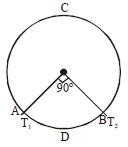
- 4For the figure shown, when arc $ACD$ and $ADB$ are made of same material, the heat carried between $A$ and $B$ is $H$ . If $ADB$ is replaced with another material, the heat carried becomes $2H$ . If the temperatures at $A$ and $B$ are fixed at $T_1$ and $T_2$ , what is the ratio of the new conductivity to the old one of $ADB$View Solution
- 5If the temperature of a hot body is increased by $50\%$ then the increase in the quantity of emitted heat radiation will be ..... $\%$View Solution
- 6View SolutionA block of metal is heated to a temperature much higher than the room temperature and allowed to cool in a room free from air currents. Which of the following curves correctly represents the rate of cooling
- 7A rod of length $L$ with sides fully insulated is of a material whose thermal conductivity varies with $\alpha$ temperature as $ K= \frac{\alpha }{T}$, where $\alpha$ is a constant. The ends of the rod are kept at temperature $T_1$ and $T_2$. The temperature $T$ at $x,$ where $x$ is the distance from the end whose temperature is $T_1$ isView Solution
- 8View SolutionThe amount of radiation emitted by a perfectly black body is proportional to
- 9View SolutionA hot and a cold body are kept in vacuum separated from each other. Which of the following cause decrease in temperature of the hot body
- 10A solid copper cube of edges $1\;cm$ is suspended in an evacuated enclosure. Its temperature is found to fall from ${100^o}C$ to ${99^o}C$ in $100\;s$. Another solid copper cube of edges $2\;cm$, with similar surface nature, is suspended in a similar manner. The time required for this cube to cool from ${100^o}C$ to ${99^o}C$ will be approximately ...... $\sec$View Solution