MCQ
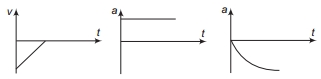
Velocity of a particle is in negative direction with constant acceleration in positive direction. Then, match the following columns.
Colum $I$ Colum $II$
$(A)$ Velocity-time graph $(p)$ Slope $\rightarrow$ negative
$(B)$ Acceleration-time graph $(q)$ Slope $\rightarrow$ positive
$(C)$ Displacement-time graph $(r)$ Slope $\rightarrow$ zero
  $(s)$ $\mid$ Slope $\mid \rightarrow$ increasing
  $(t)$ $\mid$ Slope $\mid$ $\rightarrow$ decreasing
  $(u)$ |Slope| $\rightarrow$ constant
  • A
    $( A ) \rightarrow Q , T _{;}( B ) \rightarrow Q , S ;( C ) \rightarrow P , T$
  • $( A ) \rightarrow Q , U ;( B ) \rightarrow R , U ;( C ) \rightarrow P , T$
  • C
    (A) $\rightarrow P , T ;( B ) \rightarrow R , U ;( C ) \rightarrow Q , S$
  • D
    $( A ) \rightarrow P , T ;( B ) \rightarrow Q , U ;( C ) \rightarrow Q , T$
Answer

Correct option: B.
$( A ) \rightarrow Q , U ;( B ) \rightarrow R , U ;( C ) \rightarrow P , T$
b
(b)

Corresponding $v-t, a-t$ and $s-t$ graphs are as shown below

Need a full question paper?

Generate a complete, print-ready paper with questions like this in minutes — across 16+ boards, with answer keys.

Start Generating Free

Similar questions

Binding energy of a certain nucleus is $18 \times 10^8 \mathrm{~J}$. How much is the difference between total mass of all the nucleons and nuclear mass of the given nucleus:
A uniform rod $AB$ of mass $m$ and length $l$ at rest on a smooth horizontal surface. An impulse $P$ is applied to the end $B$. The time taken by the rod to turn through a right angle is
A radio-active material is reduced to $1 / 8$ of its original amount in $3$ days. If $8 \times 10^{-3}\,kg$ of the material is left after $5$ days. The initial amount of the material is $.......\,g$
The work done in increasing the length of a metre long wire of cross-sectional area ........ $J.$ $1\,mm^2$ through $1\,mm$ will be $(Y = 2 \times 10^{11}\,Nm^{-2})$
Average force exerted on a non$-$reflecting surface at normal incidence is $2.4 \times 10^{–4}N.$ If $360 \ W/cm^2$ is the light energy flux during span of $1$ hour $30$ minutes. Then the area of the surface is:
A uniform spherical planet (Radius $R$) has acceleration due to gravity at its surface $g.$ Points $P$ and $Q$ located inside and outside the planet have acceleration due to gravity $\frac{g}{4} .$ Maximum possible separation between $P$ and $Q$ is
A particle of mass $5 × 10^{-5}\  kg$ is placed at lowest point of smooth parabola  $x^2$ = $40y$  ($x$ and $y$ in $m$) (in $rad/s$). If it is displaced slightly such that it is constrained to move along parabola, angular frequency of oscillation will be approximately
In a common base amplifier circuit, calculate the change in base current if that in the emitter current is $2\, mA$ and $\alpha = 0.98$.......$mA$
A disc of mass $1\,kg$ and radius $R$ is free of rotate about a horizontal axis passing through its centre and perpendicular to the plane of disc. A body of same mass as that of disc is fixed at the highest point of the disc. Now the system is released, when the body comes to the lowest position, its angular speed will be $4 \sqrt{\frac{x}{3 R}}$ rad s$^{-1}$ where $x=$

$\left( g =10\,ms ^{-2}\right)$

A rod of length $10\,\, cm$ lies along the principal axis of a concave mirror of focal length $10\,\, cm$ in such a way that its end closer to the pole is $20\,\, cm$ away from the mirror. The length of the image is ......$cm$