MCQ
Velocity of sound is maximum in
  • A
    Air
  • B
    Water
  • C
    Vacuum
  • Steel

Answer

Correct option: D.
Steel
d
(d) Velocity of sound in steel is maximum out of the given materials water and air.

In vacuum sound cannot travel, it's speed is zero.
 

Need a full question paper?

Generate a complete, print-ready paper with questions like this in minutes — across 16+ boards, with answer keys.
Start Generating Free

Similar questions

Vertical displacement of a plank with a body of mass $'m'$ on it is varying according to law $y = \sin \omega t + \cos \omega t.$ The minimum value of $\omega $ for which the mass just breaks off the plank and the moment it occurs first after $t = 0$ are given by : ( $y$ is positive vertically upwards)
A particle moves in space along the path $z = ax^3 + by^2$ in such a way that $\frac{dx}{dt} = c = \frac{dy}{dt}.$ Where $a, b$ and $c$ are contants. The acceleration of the  particle is
A room is maintained at ${20^o}C$ by a heater of resistance $20$ ohm connected to $200$ volt mains. The temperature is uniform through out the room and heat is transmitted through a glass window of area $1{m^2}$ and thickness $0.2$ cm. What will be the temperature outside ....... $^oC$ ? Given that thermal conductivity $K=0.2$ for glass is and $J = 4.2 J/cal$
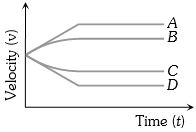
A small spherical solid ball is dropped from a great height in a viscous liquid. Its journey in the liquid is best described in the diagram given below by the
Dimensional formula for pressure head is ............
The frequency $(v)$ of an oscillating liquid drop may depend upon radius $(r)$ of the drop, density $(\rho)$ of liquid and the surface tension $(s)$ of the liquid as : $v=r^{ a } \rho^{ b } s ^{ c }$. The values of $a , b$ and $c$ respectively are
The kinetic energy of $SHM$ is $1/n$ time its potential energy. If the amplitude of the $SHM$ be $A$, then what is the displacement of the particle?
A simple pendulum of length $l$ is made to oscillate with an amplitude of $45$ degrees. The acceleration due to gravity is $g$. Let $T_0=2 \pi \sqrt{l / g}$. The time period of oscillation of this pendulum will be
Given that $v$ is speed, $r$ is the radius and $g$ is the acceleration due to gravity. Which of the following is dimensionless
For a thermodynamic process $\delta Q = -50$ $calorie$ and $W = -20$ $calorie$ . If the initial internal energy is $-30$ $calorie$ then final internal energy will be ....... $calorie$