MCQ
A small spherical solid ball is dropped from a great height in a viscous liquid. Its journey in the liquid is best described in the diagram given below by the
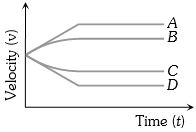
  • A
    Curve $A$
  • Curve $B$
  • C
    Curve $ C$ 
  • D
    Curve $ D$

Answer

Correct option: B.
Curve $B$
b
(b)

Need a full question paper?

Generate a complete, print-ready paper with questions like this in minutes — across 16+ boards, with answer keys.

Start Generating Free

Similar questions

Water stored in a dam possesses:
The distance between the nearest node and antinode in a stationary wave is
The maximum horizontal range of a projectile is $400\;m$.The maximum height atteined by it?
A disc of mass $1\,kg$ and radius $R$ is free of rotate about a horizontal axis passing through its centre and perpendicular to the plane of disc. A body of same mass as that of disc is fixed at the highest point of the disc. Now the system is released, when the body comes to the lowest position, its angular speed will be $4 \sqrt{\frac{x}{3 R}}$ rad s$^{-1}$ where $x=$

$\left( g =10\,ms ^{-2}\right)$

A small object placed on a rotating horizontal turn table just slips when it is placed at a distance $4\, cm$ from the axis of rotation. If the angular velocity of the turn-table is doubled, the object slips when its distance from the axis of rotation is
Water enters a pipe A with velocity v and in the vertical part of the pipe rise to a height h. If the density of water is d then the velocity v will be :
Moment of inertia of a body about a given axis is $1.5\, kg\, m^2$ Initially the body is at rest. In order to produce a rotational kinetic energy of $1200\, J$, the angular acceleration of $20\, rad/s^2$ must be applied about the axis of rotation for a duration of ......... $\sec$.
Young's modulus of a wire depends on:
Two particles of equal masses are revolving in circular paths of radii ${r_1}$ and ${r_2}$ respectively with the same speed. The ratio of their centripetal forces is
A force $\overrightarrow{ F }=4 \hat{ i }+3 \hat{ j }+4 \hat{ k }$ is applied on an intersection point of $x =2$ plane and $x$ -axis. The magnitude of torque of this force about a point $(2,3,4)$ is.......... . (Round off to the Nearest Integer)