Question
Verify that the units weber and volt-second are the same.

Answer

$\text{v}=\frac{\text{d}\phi}{\text{dt}}$

$\Rightarrow\text{d}\phi=\text{dt}$

Charge in flux has unit weber and potential difference as volt.

Need a full question paper?

Generate a complete, print-ready paper with questions like this in minutes — across 16+ boards, with answer keys.
Start Generating Free

Similar questions

A body builder exerts a force of 150N against a bullworker and compresses it by 20cm. Calculate the spring constant of the spring in the bullworker.
What is the angular acceleration of a particle moving in a circle of radius 'r' with a angular speed $'\omega'?$
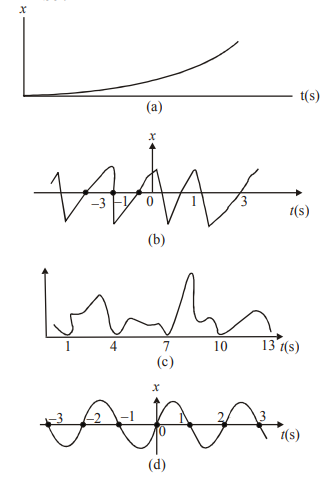
depicts four x-t plots for linear motion of a particle. Which of the plots represent periodic motion? What is the period of motion (in case of periodic motion)?
Image
Find the fundamental, first overtone and second overtone frequencies of an open organ pipe of length 20cm. Speed of sound in air is 340m/s.
It is done to accommodate the linear expansion of railway line during summer. If the gap is not left in summer, the lines will bend causing a threat of derailment.
Sound waves from a loudspeaker spread nearly uniformly in all directions if the wavelength of the sound is much larger than the diameter of the loudspeaker.
  1. Calculate the frequency for which the wavelength of sound in air is ten times the diameter of the speaker if the diameter is 20cm.
  2. Sound is essentially transmitted in the forward direction if the wavelength is much shorter than the diameter of the speaker. Calculate the frequency at which the wavelength of the sound is one tenth of the diameter of the speaker described above. Take the speed of sound to be 340m/s.
Show that the slope of p-V diagram is greater for an adiabatic process as compared to an isothermal process.
Light from Balmer series of hydrogen is able to eject photoelectrons from a metal. What can be the maximum work function of the metal?
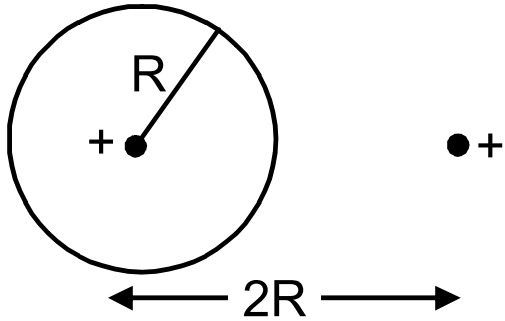
Find the flux of the electric field through a spherical surface of radius R due to a charge of 10-7C at the centre and another equal charge at a point 2R away from the centre.

Why is exposure to X-rays injurious to health but not exposure to visible light, when both are electromagnetic waves?