Question types

Magnetic Field question types

91 questions across 6 question groups — pick any mix to generate a Physics paper with step-by-step answer keys.

91
Questions
6
Question groups
5
Question types
Sample Questions

Magnetic Field questions

One sample from each question group in this chapter. Select any group above to see the full set with answer keys.

An electric current i enters and leaves a uniform circular wire of radius a through diametrically opposite points. A charged particle q moving along the axis of the circular wire passes through its centre at speed v. The magnetic force acting on the particle when it passes through the centre has a magnitude:

  1. $\text{qv}\frac{\mu_0\text{i}}{2\text{a}}$

  2. $\text{qv}\frac{\mu_0\text{i}}{2\pi\text{a}}$

  3. $\text{qv}\frac{\mu_0\text{i}}{\text{a}}$

  4. $\text{Zero}$

View full solution
A circular loop of area 1cm2, carrying a current of 10A, is placed in a magnetic field of 0.1T perpendicular to the plane of the loop. The torque on the loop due to the magnetic field is:
  1. Zero
  2. 104N-m
  3. 102N-m
  4. 1N-m
View full solution
A charged particle is whirled in a horizontal circle on a frictionless table by attaching it to a string fixed at one point. If a magnetic field is switched on in the vertical direction the tension in the string.
  1. Will increase.
  2. Will decrease.
  3. Will remain the same.
  4. May increase or decrease.
View full solution
A beam consisting of protons and electrons moving at the same speed goes through a thin region in which there is a magnetic field perpendicular to the beam. The protons and the electrons:
  1. Will go undeviated.
  2. Will be deviated by the same angle and will not separate.
  3. Will be deviated by different angles and hence separate.
  4. Will be deviated by the same angle but will separate.
View full solution
Which of the following particles will have minimum frequency of revolution when projected with the same velocity perpendicular to a magnetic field?
  1. Electron
  2. Proton
  3. He+
  4. Li+
View full solution
The free electrons in a conducting wire are in constant thermal motion. If such a wire, carrying no current, is placed in a magnetic field, is there a magnetic force on each free electron? On the wire?
View full solution
Suppose a charged particle moves with a velocity v near a wire carrying an electric current. A magnetic force, therefore, acts on it. If the same particle is seen from a frame moving with velocity v in the same direction, the charge will be found at rest. Will the magnetic force become zero in this frame? Will the magnetic field become zero in this frame?
View full solution
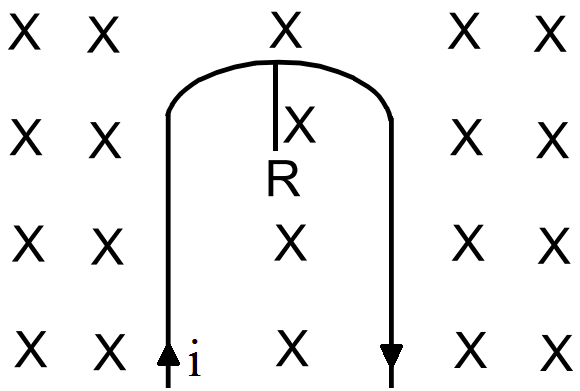
A rigid wire consists of a semi-circular portion of radius R and two straight sections The wire is partially immersed in a perpendicular magnetic field B, as shown in the figure. Find the magnetic force on the wire if it carries a current i.

View full solution
An electron beam projected along the positive X-axis deflects along the positive Y-axis. If this deflection is caused by a magnetic field, what is the direction of the field? Can we conclude that the field is parallel to the Z-axis?
View full solution
Assume that the magnetic field is uniform in a cubical region and is zero outside. Can you project a charged particle from outside into the field so that the particle describes a complete circle in the field?
View full solution
A wire, carrying a current i, is kept in the x−y plane along the curve $\text{y}=\text{A}\sin\Big(\frac{2\pi}{\lambda}\text{x}\Big).$ A magnetic field B exists in the z direction. Find the magnitude of the magnetic force on the portion of the wire between $\text{x}=0$ and $\text{x}=\lambda.$
View full solution
Q 163 Marks Question3 Marks
A proton is projected with a velocity of 3 × 10⁶ ms-1 perpendicular to a uniform magnetic field of 0.6T. Find the acceleration of the proton.
View full solution
Q 173 Marks Question3 Marks
An experimenter's diary reads as follows: "A charged particle is projected in a magnetic field of $(7.0\vec{\text{i}}-3.0\vec{\text{j}})\times10^{-3}\text{T}.$ The acceleration of the particle is found to be $(\vec{\text{i}}+7.0\vec{\text{j}})\times10\text{m/s}^{2\text{n}}.$ The number to the left of $\vec{\text{i}}$ in the last expression was not readable. What can this number be?
View full solution
Q 193 Marks Question3 Marks
A proton describes a circle of radius 1cm in a magnetic field of strength 0.10T. What would be the radius of the circle described by an α-particle moving with the same speed in the same magnetic field?
View full solution
Q 203 Marks Question3 Marks
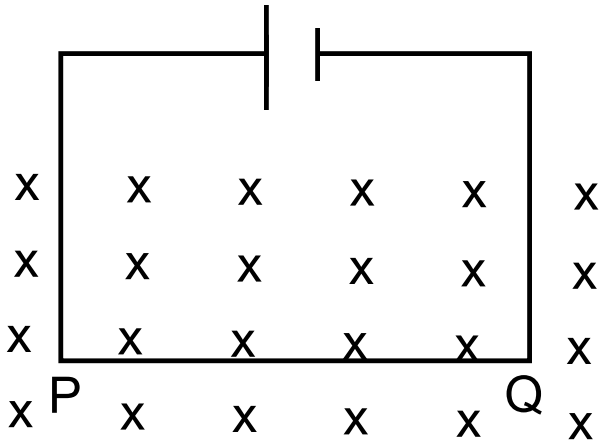
A current of 5.0A exists in the circuit shown in the figure. The wire PQ has a length of 50cm and the magnetic field in which it is immersed has a magnitude of 0.20T. Find the magnetic force acting on the wire PQ.

View full solution
Q 214 Marks Question4 Marks
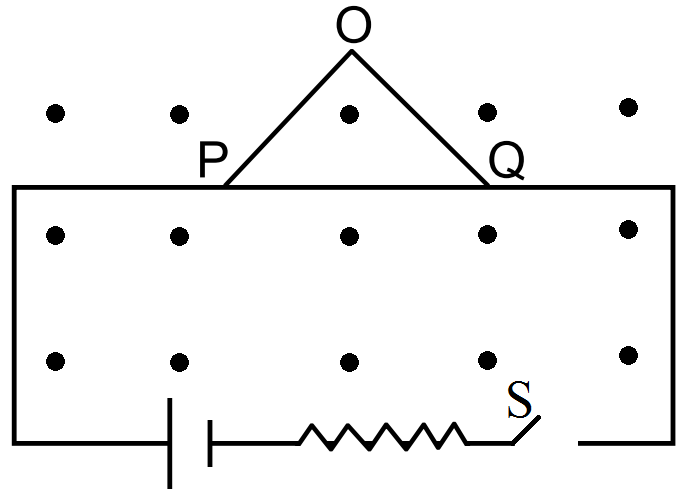
Shows a rod PQ of length 20.0cm and mass 200g suspended through a fixed point O by two threads of lengths 20.0cm each. A magnetic field of strength 0.500T exists in the vicinity of the wire PQ, as shown in the figure. The wires connecting PQ with the battery are loose and exert no force on PQ.
  1. Find the tension in the threads when the switch S is open.
  2. A current of 2.0A is established when the switch S is closed. Find the tension in the threads now.

View full solution
A proton projected in a magnetic field of 0.020T travels along a helical path of radius 5.0cm and pitch 20cm. Find the components of the velocity of the proton along and perpendicular to the magnetic field. Take the mass of the proton = 1.6 × 10⁻²⁷kg
View full solution
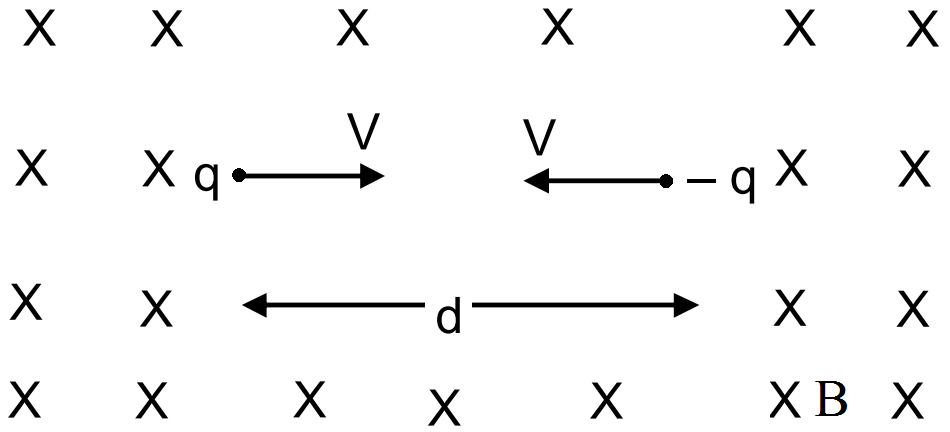
Two particles, each with mass m are placed at a separation d in a uniform magnetic field B, as shown in the figure. They have opposite charges of equal magnitude q. At time t = 0, the particles are projected towards each other, each with a speed v. Suppose the Coulomb force between the charges is switched off.
  1. Find the maximum value vm of the projection speed, so that the two particles do not collide.
  2. What would be the minimum and maximum separation between the particles if $\text{v}=\text{v}_{\text{m}}\sqrt{2}?$
  3. At what instant will a collision occur between the particles if v = 2vm?
  4. Suppose v = 2vm and the collision between the particles is completely inelastic. Describe the motion after the collision.

View full solution
Suppose that the radius of cross-section of the wire used in the previous problem is r. Find the increase in the radius of the loop if the magnetic field is switched off. Young's modulus of the material of the wire is Y.
View full solution
Consider a solid sphere of radius r and mass m that has a charge q distributed uniformly over its volume. The sphere is rotated about its diameter with an angular speed $\omega.$ Show that the magnetic moment $\mu$ and the angular momentum l of the sphere are related as $\mu=\frac{\text{q}}{2\text{m}}\text{l}.$
View full solution
A 10g bullet with a charge of $4.00\mu\text{C}$ is fired at a speed of 270m/s-1 in a horizontal direction. A vertical magnetic field of $500\mu\text{T}$ exists in the space. Find the deflection of the bullet due to the magnetic field as it travels through 100m. Make appropriate approximations.
View full solution

Generate a Magnetic Field paper free

Pick question groups from the list above, set marks and difficulty, and export a branded PDF with step-by-step answer keys. First 3 chapters free — no signup.

Download App