Question
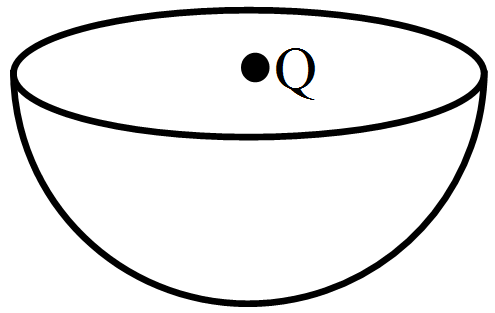
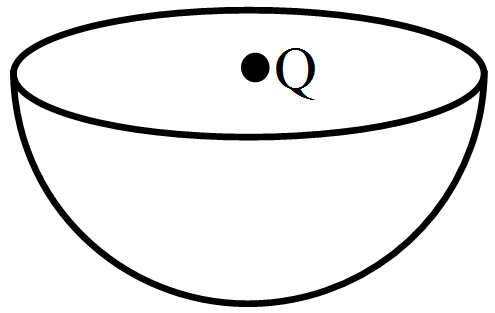
A charge Q is placed at the centre of an imaginary hemispherical surface. Using symmetry arguments and the Gauss's law, find the flux of the electric field due to this charge through the surface of the hemisphere (figure).
Answer

From Guass's law, flux through a closed surface, $\phi=\frac{\text{Q}_{\text{en}}}{\in_0},$ where $Q_{en} =$ charge enclosed by the closed surface Let us assume that a spherical closed surface in which the charge is enclosed is Q. The flux through the sphere, $\phi=\frac{\text{Q}}{\in_0}$

Hence for a hemisphere(open bowl), total flux through its curved surface, $\phi'=\frac{\text{Q}}{\in}\times\frac{1}{2}=\frac{\text{Q}}{2\in_0}$

Need a full question paper?

Generate a complete, print-ready paper with questions like this in minutes — across 16+ boards, with answer keys.

Start Generating Free

Similar questions

The internal resistance of an accumulator battery of emf 6V is $10\Omega$ when it is fully discharged. As the battery gets charged up, its internal resistance decreases to $1\Omega.$
The battery in its completely discharged state is connected to a charger that maintains a constant potential difference of 9V. Find the current through the battery (a) just after the connections are made and (b) after a long time when it is completely charged.
A U- tube containing a liquid is accelerated horizontally with a constant acceleration $a_0$. If the separation between the vertical limbs is 1, find the difference in the heights of the liquid in the two arms.
A uniform electric field of $10NC^{-1}$ exists in the vertically downward direction. Find the increase in the electric potential as one goes up through a height of 50cm.
A ball of superconducting material is dipped in liquid nitrogen and placed near a bar magnet.
i. In which direction will it move?
ii. What will be the direction of its magnetic moment?
Current is allowed to flow in a metallic wire at a constant potential difference. When the wire becomes hot, cold water is poured on half of its portion. By doing so, its other half portion becomes still more hot. Explain its reason.
Identify the electromagnetic waves whose wavelengths lie in the range:
  1. $10^{-11} \mathrm{~m}<\lambda<10^{-14} \mathrm{~m}$
  2. $10^{-4} \mathrm{~m}<\lambda<10^{-6} \mathrm{~m}$
Write one use for each.
Why cannot longitudinal waves be polarized?
Light is incident from glass $(\mu=1.5)$ to air. Sketch the variation of the angle of deviation $\delta$ with the angle of incident i for 0 < i < 90°.
Do two positively charged balls attract each other?
Explain paramagnetism and paramagnetic substances.