Question
Verify the division algorithm i.e., Dividend = Divisor $\times $ Quotient + Remainder, in the following. Also write the quotient and remainder.
Dividend: $15z^3- 20z^2+ 13z - 12$
Divisor: $3z - 6$
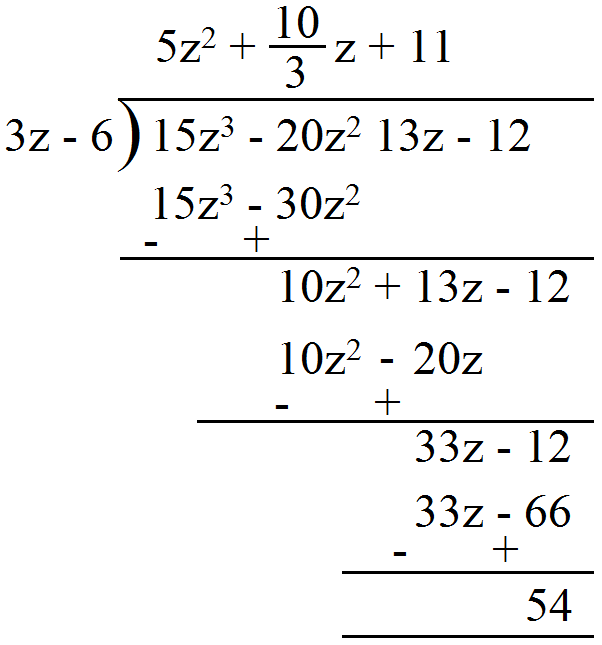
Answer


Quotient $=5\text{z}^2+\frac{10}{3}\text{z}+11$
Remainder $=54$ Divisor $\times $ Quotient + Remainder $=(3\text{z}-6)\Big(5\text{z}^2+\frac{10}{3}\text{z}+11\Big)+54$
$=15\text{z}^3+10\text{z}^2+33\text{z}-30\text{z}^2-20\text{z}-66+54$
$15\text{z}^3-20\text{z}^2+13\text{z}-12$
$=\text{Dividend}$
Thus, Divisor $\times $ Quotient + Remainder = Dividend
Hence verified.

Need a full question paper?

Generate a complete, print-ready paper with questions like this in minutes — across 16+ boards, with answer keys.

Start Generating Free

Similar questions

Examine each statement below and find out if it is ‘Always True’, ‘Only Sometimes True’, or ‘Never True’. Explain your reasoning.
(i) Cube numbers are also square numbers.
(ii) Fourth powers are also square numbers.
(iii) The fifth power of a number is divisible by the cube of that number.
(iv) The product of two cube numbers is a cube number.
(v) q46 is both a 4th power and a 6th power (q is a prime number).
A village, having a population of $4000$ requires $150$ litres water per head per day. It has a tank which is $20m$ long, $15m$ broad and $6m$ high. For how many days the water of this tank will last?
Sheela deposited $Rs. 20000$ in a bank, where the interest is credited half-yearly. If the rate of interest paid by the bank is $6\%$ per annum, what amount will she get after $1$ year$?$
If an angle of a parallelogram is two-third of its adjacent angle, find the angles of the parallelogram.
Express the following numbers in usual form.
(i) $3.02 \times 10^{-6}$
(ii) $4.5 \times 10^4$
(iii) $3 \times 10^{-8}$
(iv) $1.0001 \times 10^9$
(v) $5.8 \times 10^{12}$
(vi) $3.61492 \times 10^6$
The sum of the digits of a two-digit number is $12.$ If the new number formed by reversing the digits is greater than the original number by $54,$ find the original number. Check your solution.
Find the cube root of the following rational numbers:
$0.001728$
In a television game show, the prize money of ₹ 100000 is to be divided equally amongst the winners. Complete the following table and find whether the prize money given to an individual winner is directly or inversely proportional to the number of winners?
Number of winnersPrize for each winner (in ₹)
1100000
250000
4
5
8
10
20
If $2x + 3y = 14$ and $2x - 3y = 2,$ find the value of $xy$. $[$Hint: Use $(2x + 3y)^2- (2x - 3y)^2= 24xy]$
$9\frac{1}{4}=\text{y}-1\frac{1}{3}$