Question
Verify the division algorithm i.e., Dividend = Divisor $\times $ Quotient + Remainder, in the following.
Also write the quotient and remainder.
Dividend: $15\text{y}^4-16\text{y}^3+9\text{y}^2-\frac{10}{3}\text{y}+6$
Divisor: $3\text{y}-2$
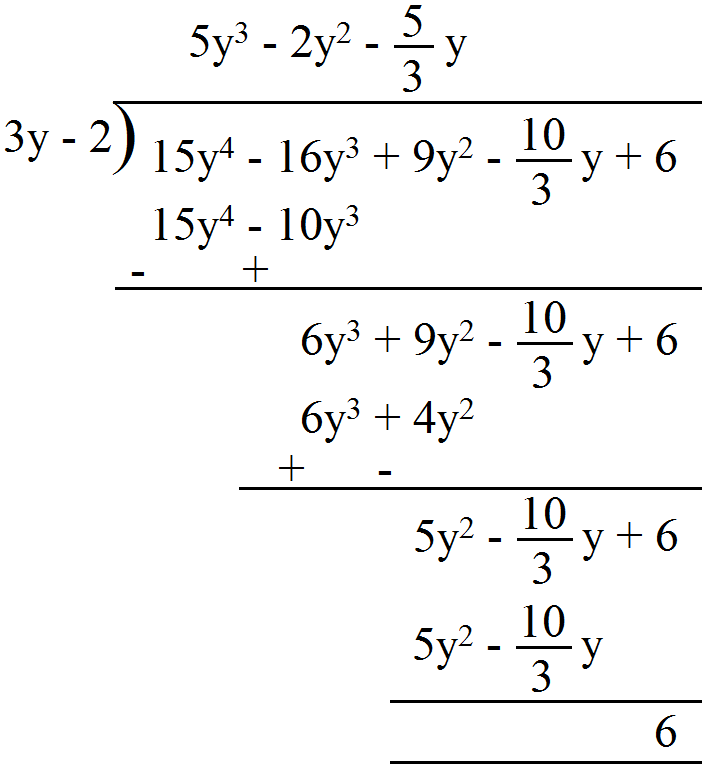
Answer


Quotient $5\text{y}^3-2\text{y}^2+\frac{5}{3}\text{y}$
Remainder $=6$
Divisor $=3\text{y}-2$ Divisor $\times $ Quotient + Remainder
$=\Big(3\text{y}-2\Big)\Big(5\text{y}^3-2\text{y}^2+\frac{5}{3}\text{y}\Big)+6$
$156\text{y}^4-6\text{y}^3+5\text{y}^3+4\text{y}^2-\frac{10}{3}\text{y}+6$
$=15\text{y}^4-16\text{y}^3+9\text{y}^2-\frac{10}{3}\text{y}+6$
$=\text{Dividend}$
Divisor $\times $ Quotient + Remainder = Dividend Hence verified.

Need a full question paper?

Generate a complete, print-ready paper with questions like this in minutes — across 16+ boards, with answer keys.

Start Generating Free

Similar questions

Find the difference between the simple interest and the compound interest on $Rs. 5000$ for $2$ years at $9\%$ per annum.
Find the least number which must be subtracted from $1989$ so as to get a perfect square. Also find the square root of the perfect square so obtained.
The difference betwen two selling prices of a shirt at profits of $4\%$ and $5\%$ is $Rs. 6$. Find $(i)$ $C.P.$ of the shirt $(ii)$ The two selling prices of the shirt
Find the following product and verify the result for $x = -1, y = -2: (3x - 5y) (x + y)$
Plot the points $(2, 8), (7, 8)$ and $(12, 8)$. Join these points in pairs. Do they lie on a line? What do you observe?
Write down the product of $-8x^2y^6$ and $-20xy$. Verify the product for $x = 2.5, y = 1.$
Construct a quadrilateral $ABCD$ in which $AB = 3.8\ cm, BC = 3.4\ cm, CD = 4.5\ cm, AD = 5\ cm$ and $\angle\text{B}=80^\circ.$
Evaluate following when $x = 2, y = −1$. $$$\big(\frac{3}{5}\text{x}^2\text{y}\big)×\big(−\frac{15}{4}\text{xy}^2\big)×\big(\frac{7}{9}\text{x}^2\text{y}^2)$
Diagonals of parallelogram $\text{ABCD}$ intersect at $O$ as shown in the figure. $\text{XY}$ contains $O$, and $\text{X, Y}$ are points on opposite sides of the parallelogram. Give reasons for each of the following:
$i. \text{OB}=\text{OD}$
$ii. \angle\text{OBY}=\angle\text{ ODX}$
$iii. \angle\text{BOY}=\angle\text{DOX}$
$iv. \triangle\text{BOY}=\triangle\text{DOX}$
Now, state if $\text{XY}$ is bisected at $O$.
Find the cubes of the following number by column method: $72$