Question
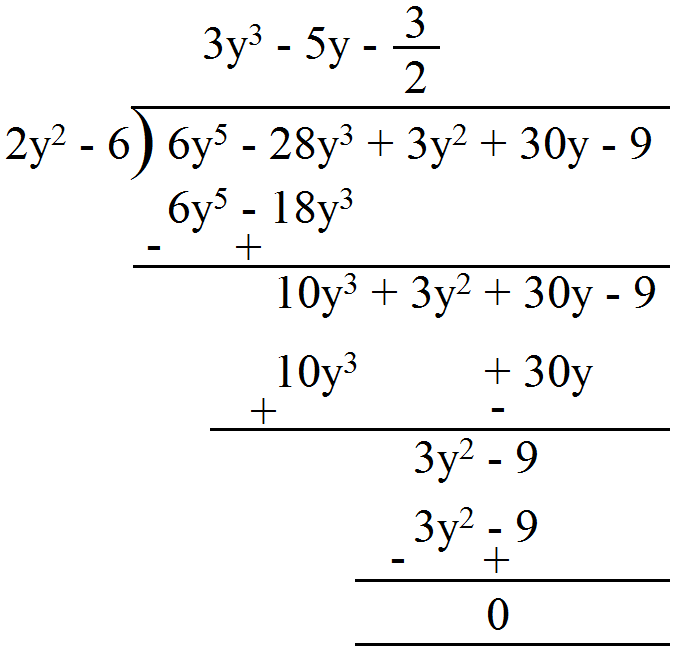
Verify the division algorithm i.e., Dividend = Divisor $\times $ Quotient + Remainder, in the following. Also write the quotient and remainder.
Dividend: $6y^5- 28y^2+ 30y - 9$
Divisor: $2y^2- 6$
Answer


Quotient $=3\text{y}^3-5\text{y}+\frac{3}{2}$
Remainder $=0$
Divisor $=2\text{y}^2-6$
Divisor $\times $ Quotient + Remainder = $\Big(2\text{y}^2-6\Big)\Big(3\text{y}^3-5\text{y}+\frac{3}{2}\Big)+0$
$=6\text{y}^5-10\text{y}^3+3\text{y}^2-18\text{y}^3+30\text{y}-9$
$=6\text{y}^5-28\text{y}^3+3\text{y}^2+30\text{y}-9$
$=\text{Dividend}$ Thus, Divisor $\times $ Quotient + Remainder = Dividend Hence verified.

Need a full question paper?

Generate a complete, print-ready paper with questions like this in minutes — across 16+ boards, with answer keys.

Start Generating Free

Similar questions

Making use of the cube root table, find the cube root $1346$
The external dimensions of a closed wooden box are $62\ cm, 30\ cm$ and $18\ cm$. If the box is made of $2\ cm$-thick wood, find the capacity of the box.
The parallel sides of a trapezium are $20\ cm$ and $10\ cm.$ Its nonparallel sides are both equal, each being $13\ cm.$ Find the area of the trapezium.
Salma and Abid factorise the algebraic expression $p^4+9 p^2+18$
Salma
$
\begin{aligned}
p^4+9 p^2+18 & =p^4+6 \rho^2+3 p^2+18 \\
& =p^2\left(p^2+6\right)+3\left(p^2+6\right) \\
& =\left(p^2+3\right)\left(p^2+6\right)
\end{aligned}
$
Abid
$
\begin{aligned}
p^4+9 p^2+18 & =p^4+6 p+3 p+18 \\
& =p\left(p^3+6\right)+3(p+6) \\
& =\left(p^3+6\right)(p+6)(p+3)
\end{aligned}
$
Who is correct? Give a reason to justify your answer.
Plot a line graph for the variables $p$ and $q$, where $p$ is four times $q$, i.e., the equation is $p = 4q$. Using the graph, find the value of,
$i. p$, when $q = 6$ and
$ii. q$, when $p = 20$
Find whether, or not the first polynomial is a factor of the second:
$\frac{3\text{y}^3+5\text{y}^2+5\text{y}+2}{\text{y}-2}$
The product of two numbers is $1296$. If one number is $16$ times the other, find the numbers.
Is the product of two consecutive integers always multiple of 2? Why? What about the product of these consecutive integers? Is it always a multiple of 6? Why or why not? What can you say about the product of 4 consecutive integers? What about the product of five consecutive integers?
Solve the following equation and also check your result in case: $\frac{(1-2\text{x})}{7}-\frac{(2-3\text{x})}{8}=\frac{3}{2}+\frac{\text{x}}{4}$
A cycle dealer offers a discount of $10\%$ and still makes a profit of $26\%$. What is the actual cost to him of a cycle whose marked price is $Rs\ 840$?