Question
Verify, whether points $P(6,-6), Q(3,-7)$ and $R(3,3)$ are collinear.

Answer

$\mathrm{PQ}=\sqrt{(6-3)^2+(-6+7)^2}$ by distance formula
$
\begin{aligned}
& =\sqrt{(3)^2+(1)^2}=\sqrt{10} \\
\mathrm{QR} & =\sqrt{(3-3)^2+(-7-3)^2} \\
& =\sqrt{(0)^2+(-10)^2}=\sqrt{100} \\
\mathrm{PR} & =\sqrt{(3-6)^2+(3+6)^2} \\
& =\sqrt{(-3)^2+(9)^2}=\sqrt{90} .
\end{aligned}
$
From I, II and III out of $\sqrt{10}, \sqrt{100}$ and $\sqrt{90}, \sqrt{100}$ is the largest number.
Now we will verify whether $(\sqrt{100})$ and $(\sqrt{10}+\sqrt{90})$ are equal.
For this compare $(\sqrt{100})^2$ and $(\sqrt{10}+\sqrt{90})^2$.
You will see that $(\sqrt{10}+\sqrt{90})>(\sqrt{100}) \therefore \mathrm{PQ}+\mathrm{PR} \neq \mathrm{QR}$
$\therefore$ points $\mathrm{P}(6,-6), \mathrm{Q}(3,-7)$ and $\mathrm{R}(3,3)$ are not collinear.

Need a full question paper?

Generate a complete, print-ready paper with questions like this in minutes — across 16+ boards, with answer keys.
Start Generating Free

Similar questions

Find the $10^{\text {th }}$ term from the end of the A.P. $4,9,14, \ldots, 254$.
In $\triangle\text{ABC and }\triangle\text{DEF},$ it is being given that: AB = 5cm, BC = 4cm and CA = 4.2cm; DE = 10cm, EF = 8cm and FD = 8.4cm. If $\text{AL}\perp\text{BC}$ and $\text{DM} \perp \text{EF,}$ find AL : DM.
Find the value of k for which the following systems of linear equations has an infinite number of solutions:
$5x + 2y = 2k,$
$2(k + 1)x + ky = (3k + 4).$
Find the common difference of the A.P. and write the next two terms:
$51, 59, 67, 75, .....$
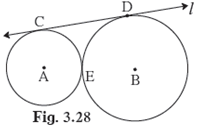
In fig 3.28 the circles with centres A and B touch each other at E. Line is a common tangent which touches the circles at C and D respectively. Find the length of seg CD if the radii Fig. 3.28 of the circles are 4 cm, 6 cm.
If the face value of both the shares is same, then which investment out of the following is more profitable?
Company A : dividend 16%, MV = Rs. 80, Company B : dividend 20%, MV = Rs. 120.
If $3\cos\theta=1,$ find the value of $\frac{6\sin^2\theta+\tan^2\theta}{4\cos\theta}$.
$\triangle X Y Z \sim \Delta ABC , \angle X=40^{\circ}, \angle Y=80^{\circ}, X Y=6 cm$. Draw $\triangle ABC$, if $AB : XY =3: 2$
A vessel in the shape of a cuboid contains some water. If three identical spheres immersed in the water, the level of water is increased by $2\ cm$.
If the area of the base of the cuboid is $160\ cm^2$ and its height $12\ cm$, determine the radius of any of the spheres.
The sum of father’s age and twice the age of his son is 70. If we double the age of the father and add it to the age of his son the sum is 95. Find their present ages.