MCQ
Vibration magnetometer before use, should be set
  • In magnetic meridian
  • B
    In geographical meridian
  • C
    Perpendicular to magnetic meridian
  • D
    In any position

Answer

Correct option: A.
In magnetic meridian
a
Vibration magnetometer before use, should be set in magnetic meridian because no any extra force is applied in this condition.

Need a full question paper?

Generate a complete, print-ready paper with questions like this in minutes — across 16+ boards, with answer keys.
Start Generating Free

Similar questions

Nuclear forces are
A dielectric slab of thickness $d$ is inserted in a parallel plate capacitor whose negative plate is at $x = 0$ and positive plate is at $x = 3d$. The slab is equidistant from the plates. The capacitor is given some charge. As one goes from $0$ to $3d$
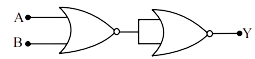
In the following circuit, the output $Y$ for all possible inputs $A$ and $B$ is expressed by the truth table.
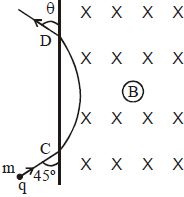
A particle of mass $m = 1.67 \times 10^{-27}\, kg$ and charge $q = 1.6 \times 10^{-19} \, C$ enters a region of uniform magnetic field of strength $1$ $tesla$ along the direction shown in the figure. the particle leaves the magnetic field at point $D,$ then the distance $CD$ is :-
Two parallel wires carry currents of $20A$ and $40A$ in opposite directions. Another wire carying a current anti parallel to $20A$ is placed midway between the two wires. $T$ he magnetic force on it will be:
A galvanometer of $50$ ohm resistance has $25$ divisions. A current of $4 × 10^{-4}$  ampere gives a deflection of one division. To convert this galvanometer into a voltmeter having a range of $25$ volts, it should be connected with a resistance of
Which of the following has a negative temperature coefficient.
In the depletion region of a diode:
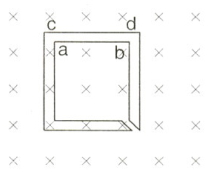
The figure shows certain wire segments joined together to form a coplanar loop. The loop is placed in a perpendicular magnetic field in the direction going into the plane of the figure. The magnitude of the field increases with time. $I_1$ and $I_2$ are the currents in the segments $ab$ and $cd$. Then,
The temperature coefficient of resistance for a wire is 0.00125/℃. At 300K its resistance is 1 ohm. The temperature at which the resistance becomes 2 ohm is