MCQ
Viscous drag force depends on ...........
  • A
    Size of body
  • B
    Velocity with which it moves
  • C
    Viscosity of fluid
  • All of these

Answer

Correct option: D.
All of these
d
(d)

$F=\eta A \frac{V}{d}$   $\left\{\begin{array}{l}\text { Where, } \\ F=\text { Drag Force } \\ \eta=\text { Viscosity of fluids } \\ A=\text { Area } \propto \text { size of body } \\ V=\text { Velocity }\end{array}\right.$

Need a full question paper?

Generate a complete, print-ready paper with questions like this in minutes — across 16+ boards, with answer keys.
Start Generating Free

Similar questions

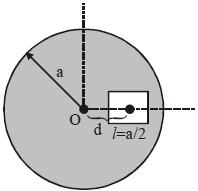
A square shaped hole of side $l=\frac{a}{2}$ is carved out at a distance $d =\frac{ a }{2}$ from the centre $'O'$ of a uniform circular disk of radius $a$. If the distance of the centre of mass of the remaining portion from $O$ is $-\frac{a}{X},$ value of $X$ (to the nearest integer) is.......
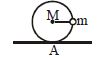
A uniform body of mass $M$  radius $R$ has a small mass $m$ attached at edge as shown in the figure. The system is placed on a perfectly rough horizontal surface such that mass $m$ is at the same horizontal level as the centre of body. It is assumed that there is no slipping at point $A$. If $I_A$ is the moment of the inertia of combined system about point of contact $A$ then the normal reaction at point $A$ just after the system is released from rest is ........ $N$. ($M = 6\ kg$, $m = 2\ kg,$ $I_A = 4\ kg\ m^2$, $R = 1\ m$, $g=10\ m/s^2$)
The mass of a particle is $1\,\,kg$ and it is moving along  $x-$ axis. The period of its small oscillation is $\frac {\pi }{2}$ . Its potential energy may be
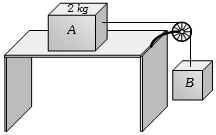
The coefficient of static friction, ${\mu _s},$ between block $A$ of mass $2\, kg$ and the table as shown in the figure is $0.2$. ........ $kg$ would be the maximum mass value of block $B$ so that the two blocks do not move. The string and the pulley are assumed to be smooth and massless. $(g = 10\,m/{s^2})$
A gas at initial temperature $T$ undergoes sudden expansion from volume $V$ to $2 \,V$. Then,
A cricket ball of mass 150g moving with a speed of 126km/ h hits at the middle of the bat, held firmly at its position by the batsman. The ball moves straight back to the bowler after hitting the bat. Assuming that collision between ball and bat is completely elastic and the two remain in contact for 0.001s, the force that the batsman had to apply to hold the bat firmly at its place would be:
  1. 10.5N
  2. 21N
  3. 1.05 × 104
  4. N
  5. 2.1 × 104N
A nucleus moving with a velocity $\vec{\text{v}}$ emits an α-particle. Let the velocities of the α-particle and the remaining nucleus be $\vec{\text{v}}_1$ and $\vec{\text{v}}_2$ and their masses be m1 and m2.

  1. $\vec{\text{v}},\ \vec{\text{v}}_1$ and $\vec{\text{v}}_2$ must be parallel to each other.

  2. None of the two of $\vec{\text{v}},\ \vec{\text{v}}_1$ and $\vec{\text{v}}_2$ should be parallel to each other.

  3. $\vec{\text{v}}_1+\vec{\text{v}}_2$ must be parallel to $\vec{\text{v}}.$

  4. $\text{m}_1\vec{\text{v}}_1+\text{m}_2\vec{\text{v}}_2$ must be parallel to $\vec{\text{v}}.$

A satellite moves round the earth in a circular orbit of radius $R$ making one revolution per day. A second satellite moving in a circular orbit, moves round the earth once in $8$ days. The radius of the orbit of the second satellite is
Which of the following does not have potential energy ?
A particle moves in the $xy$ plane with a constant acceleration $'g'$ in the negative $y$-direction. Its equation of motion is $y = ax-bx^2$, where $a$ and $b$ are constants. Which of the following are correct?