Question
Vocational training copleents traditional education by providing practical skills and hands-on experience. While education equips individuals with a broad knowledge base, vocational training focuses on job-specific skills, enhancing eployability thus aking the student self-reliant. Keeping this in view, a teacher ade the following table grving the frequency distribution of students/adults undergoing vocational training fro the training institute.
Iage
Age (in years)15-1920-2425-2930-3435-3940-4445-4950-54
Nuber of participants6213296371311104

Fro the above, answer the following questions:
(i) What is the lower liit of the odal class of the above data?
(ii) (a) Find the edian class of the above data.
OR
(b) Find the nuber of participants of age less than 50 years who undergo vocational training.
(iii) Give the epirical relationship between ean, edian and ode.

Need a full question paper?

Generate a complete, print-ready paper with questions like this in minutes — across 16+ boards, with answer keys.

Start Generating Free

Similar questions

An aeroplane is flying at a height of 210m. Flying at this height at some instant the angles of depression of two points in opposite directions on both the banks of the river are 45º and 60º. Find the width of the river. $(\text{Use }\sqrt{3}=1.73)$
Amit was playing a number card game. In the game, some number cards (having both +ve or-ve
numbers) are arranged in a row such that they are following an arithmetic progression. On his first turn, Amit picks up 6th and 14th card and finds their sum to be -76. On the second turn he picks up 8th and 16th card and finds their sum to be -96.ased on the above information, answer the following questions.
(i) What is the difference between the numbers on any two consecutive cards?
(ii) The number on first card is,
(iii) What is the number on the 19th card?
OR
What is the number on the 23rd card?
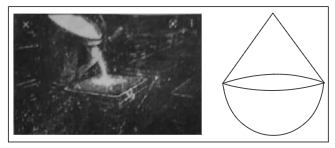
A company deals in casting and moulding of metal on orders received from its clients.
Image
The tent is in the shape of a cylinder surmounted by a conical top. If the height and diameter of cylindrical part are 9 m and 30 m respectively and height of conical part is 8 m with same diameter as that of the cylindrical part, then find
(1) The area of the canvas used in making the tent;
(2) The cost of the canvas bought for the tent at the rate Rs. 200 per sq. m, if 30 sq. m canvas was wasted during stitching.
Mathematics teacher of a school took the standard 10 students to see the painting exhibition which was held at ART COLLEGE OF EDUCATION, Bangalore. It is the part of art integration of Mathematics. The teacher and students had interest in painting as well. Students were eager to see the above paintings. The teacher explained that the above paintings are based on concept of a pair of linear equations of two variables.
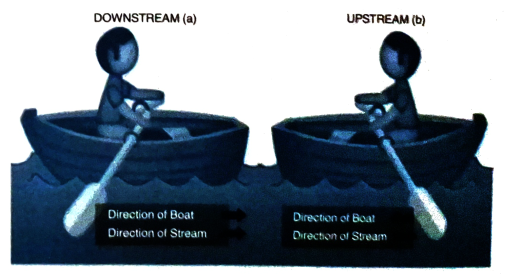
Image
(i) If the speed of boat is $5 km / hr$ and speed of stream is $2 km / hr$. What is the speed of the boat in downstream?
(a) $5 km / hr$ $\qquad$ (b) $2 km / hr$ $\qquad$ (c) $7 km / hr$ $\qquad$ (d) $3 km / hr$
(ii) If the speed of boat is $5 km / hr$ and speed of stream is $2 km / hr$. What is the speed of the boat in upstream?
(a) $5 km / hr$ $\qquad$ (b) $2 km / hr$ $\qquad$ (c) $7 km / hr$ $\qquad$ (d) $3 km / hr$
(iii) A boat goes 21 km downstream. What is the time required to cover it?
(a) 5 hr $\qquad$ (b) 2 hr $\qquad$ (c) 7 hr $\qquad$ (d) 3 hr
(iv) A boat goes 12 km upstream. What is the time required to cover it?
(a) 4 hr $\qquad$ (b) 2 hr $\qquad$ (c) 6 hr $\qquad$ (d) 3 hr

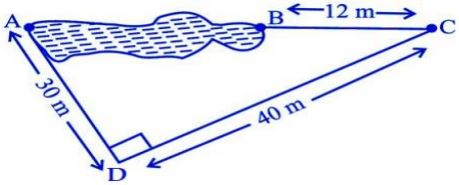
Rohan wants to measure the distance of a pond during the visit to his native. He marks points A and B on the opposite edges of a pond as shown in the figure below. To find the distance between the points, he makes a right-angled triangle using rope connecting B with another point C are a distance of 12m, connecting C to point D at a distance of 40m from point C and the connecting D to the point A which is are a distance of 30m from D such the $\angle ADC=90^0.$
  1. Which property of geometry will be used to find the distance AC?
  2. Find the length AB?
  3. Which is the following does not form a Pythagoras triplet?
    Or
    Find the length of the rope used.
Read the following text carefully and answer the questions that follow:
Using Cartesian Coordinates we mark a point on a graph by how far along and how far up it is.
The left $-$ right $($horizontal$)$ direction is commonly called $X-$ axis.
The up $-$ down $($vertical$)$ direction is commonly called $Y-$ axis.
When we include negative values, the $x$ and $y$ axes divide the space up into $4$ pieces.
Read the information given above and below:
Two friends Veena and Arun work in the same office in Delhi. In the Christmas vacations, both decided to go
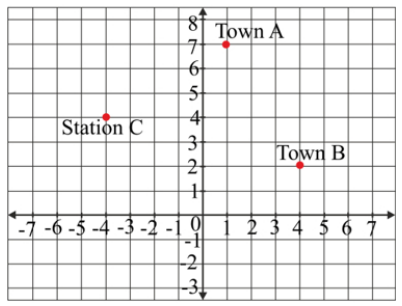
their hometowns represented by Town $A$ and Town $B$ respectively in the figure given below. Town A and Town $B$ are connected by trains from the same station $C\ ($in the given figure$)$ in Delhi.
Image
$i$. Who will travel more distance to reach their home? $(1)$
$ii.$ Find the location of the station. $(1)$
$iii$. Find in which ratio $Y-$ axis divide Town $B$ and Station. $(2)$
OR
Find the distance between Town $A$ and Town $B. (2)$
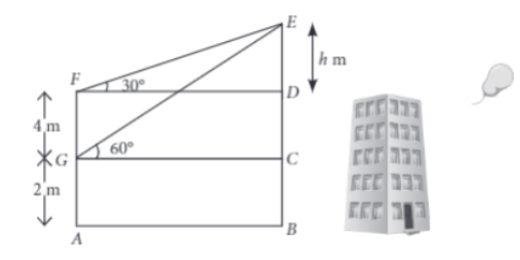
There are two windows in a house. First window is at the height of 2 m above the
ground and other window is 4 m vertically above the lower window. Ankit and Radha
are sitting inside the two windows at points G and F respectively. At an instant, the
angles of elevation of a balloon from these windows are observed to be 60° and 30° as
shown below-

Based on the above information, answer the following questions.
(i) Who is more closer to the balloon, Radha or Ankit?
(ii) Value of DF is equal to
(iii) Value of h is
OR
Height of the balloon from the ground is

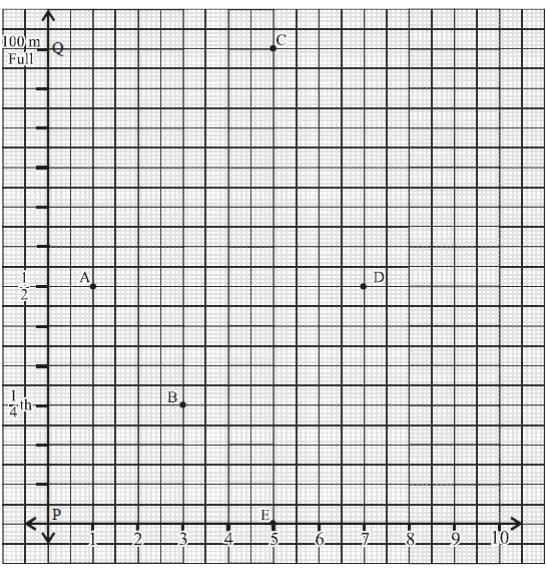
RPVV, Suraj Mal organised Sports Day in which one of the event is 100 m race. Participants
have to run in the rows which are marked at a distance of 1 metre as shown in the figure. At
one time the participants are at position A, B, C, D. A has covered half the distance PQ, B has
covered 1/4th distance PQ, C has covered the distance PQ, D has covered half the distance
PQ. Considering P as origin, answer the questions given below the diagram.

Based on the above information, answer the following questions.
(i) On joing A, B, C, D which figure you will get?
(ii) What area is enclosed by ABCD ?
(iii) If another participant at E could not run due to some shoe problem, what are the co-odinates of E
OR
In what ratio B divides AE?

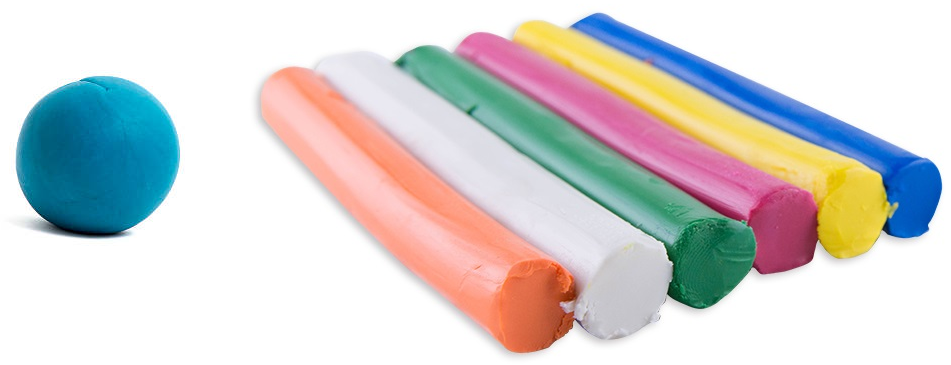
To make the learning process more interesting, creative and innovative, Amayras' class teacher brings clay in the classroom, to teach the topic-Surface Areas and Volumes. With clay, she forms a cylinder of radius 6cm and height 8cm. Then she moulds the cylinder into a sphere and asks some questions to students.
  1. During the conversion of a solid from one shape to another the volume of new shape will be Increase, Decrease or Remain unaltered?
  2. The radius of the sphere so fanned is:
  3. The volume of the sphere so formed is:
    Or
    Find the ratio of the volume of sphere to the volume of cylinder.