MCQ
Voltage in the secondary coil of a transformer does not depend upon.
  • A
    Voltage in the primary coil
  • B
    Ratio of number of turns in the two coils
  • Frequency of the source
  • D
    Both $(a)$ and $(b)$

Answer

Correct option: C.
Frequency of the source
c
(c) The voltage in primary and secondary coil is related as:

$\Rightarrow \frac{V_{S}}{V_{P}}=\frac{\text {no. of turns in secondary coil }\left(N_{s}\right)}{\text { no. of turns in primary coil }\left(N_{p}\right)}$

Clearly, voltage in secondary coil depends on voltage in primary coil and number of turns in primary and secondary coil. It is independent of frequency of the source.

Need a full question paper?

Generate a complete, print-ready paper with questions like this in minutes — across 16+ boards, with answer keys.
Start Generating Free

Similar questions

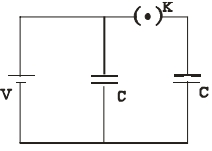
A source of potential difference $V$ is connected to the combination of two identical capacitors as shown in the figure. When key ' $K$ ' is closed, the total energy stored across the combination is $E _{1}$. Now key ' $K$ ' is opened and dielectric of dielectric constant 5 is introduced between the plates of the capacitors. The total energy stored across the combination is now $E _{2}$. The ratio $E _{1} / E _{2}$ will be :
A student measures the focal length of a convex lens by putting an object pin at a distance '$u$' from the lens and measuring the distance '$v$' of the image pin. The graph between '$u$' and '$v$' plotted by the student should look like
The graph between the instantaneous concentration $(N)$ of a radioactive element and time $(t)$ is
The nuclear activity of a radioactive element becomes $\left(\frac{1}{8}\right)^{\text {th }}$ of its initial value in $30\, years.$ The half-life of radioactive element is $....\,years.$
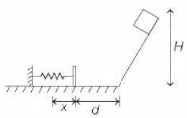
A block of mass $m$ slides from rest at a height $H$ on a frictionless inclined plane as shown in the figure. It travels a distance $d$ across a rough horizontal surface with coefficient of kinetic friction $\mu$ and compresses a spring of spring constant $k$ by a distance $x$ before coming to rest momentarily. Then the spring extends and the block travels back attaining a final height of $h$. Then,
A tangential force $F$ is applied on a disc of radius $R$, due to which it deflects through an angle $\theta $ from its initial position. The work done by this force would be
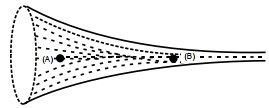
The figure shows a liquid of given density flowing steadily in horizontal tube of varying cross-section. Cross sectional areas at $A$ is $1.5\,cm ^2$, and $B$ is $25\,mm ^2$, if the speed of liquid at $B$ is $60\,cm / s$ then $\left( P _{ A }- P _{ B }\right)$ is :(Given $P _{ A }$ and $P _{ B }$ are liquid pressures at $A$ and $B$ points.Density $\rho=1000\,kg\,m ^{-3}$

$A$ and $B$ are on the axis of tube $............\,Pa$
A $220\, V$, $50 \,Hz$ $ac$ source is connected to an inductance of $0.2\,H$ and a resistance of $20\, ohm$ in series. What is the current in the circuit.......$A$
An electron moves in a circular orbit with a uniform speed $v$. It produces a magnetic field $B$ at the centre of the circle. The radius of the circle is proportional to
${K_\alpha }$characteristic $X- $ ray refers to the transition