MCQ
Volt/metre is the unit of
  • A
    Potential
  • B
    Work
  • C
    Force
  • Electric intensity

Answer

Correct option: D.
Electric intensity
d
(d) $E = - \frac{{dV}}{{dx}}$

Need a full question paper?

Generate a complete, print-ready paper with questions like this in minutes — across 16+ boards, with answer keys.
Start Generating Free

Similar questions

A monkey of mass $20\,kg$ is holding a vertical rope. The rope will not break when a mass of $25\, kg$ is suspended from it but will break if the mass exceeds $25 \,kg$. What is the maximum acceleration with which the monkey can climb up along the rope ............ $m/{s^2}$ $(g = 10\,m/{s^2})$
Longitudinal stress of $1\,kg/m{m^2}$ is applied on a wire. The percentage increase in length is $(Y = {10^{11}}\,N/{m^2})$
Three $\alpha - $ particles and one $\beta - $ particle decaying takes place in series from an isotope $_{88}R{a^{238}}$. Finally the isotope obtained will be
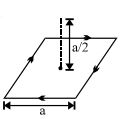
The magnetic field due to a current carrying square loop of side a at a point located symmetrically at a distance of $a/2$ from its centre (as shown is)
The motion of a particle represented by $y\ =$ $\sin \omega t - \cos \omega t$ is
A pendulum bob has a speed of $3\, {m} / {s}$ at its lowest position. The pendulum is $50 \,{cm}$ long. The speed of bob, when the length makes an angle of $60^{\circ}$ to the vertical will be $ .......\,{m} / {s}$ $\left(g=10 \,{m} / {s}^{2}\right)$
A block of mass $M$ placed inside a box descends vertically with acceleration $'a'$. The block exerts a force equal to one-fourth of its weight on the floor of the box. The value of $'a'$ will be .............
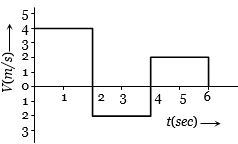
The velocity-time graph of a body moving in a straight line is shown in the figure. The displacement and distance travelled by the body in $6\, sec$ are respectively
A particle experiences a constant acceleration for $20\, seconds$ after starting from rest. If it travels a distance $s_1$ in the first $10\, seconds$ and distance $s_2$ in the next $10\, seconds$, then :-
In the diagram resistance between any two junctions is $R$. Equivalent resistance across terminals $A$ and $B$ is