The motion of a particle represented by $y\ =$ $\sin \omega t - \cos \omega t$ is
Medium


Download our appand get started for free
Experience the future of education. Simply download our apps or reach out to us for more information. Let's shape the future of learning together!No signup needed.*
Similar Questions
- 1View SolutionThe value of maximum possible amplitude in the case of forced oscillations when driving frequency is close to natural frequency is
- 2In a simple pendulum, the period of oscillation $T$ is related to length of the pendulum $l$ asView Solution
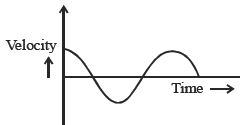
- 3View SolutionThe graph in figure represents
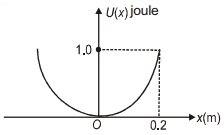
- 4A particle of mass $4 \,kg$ moves simple harmonically such that its $P E(U)$ varies with position $x$, as shown. The period of oscillations is ............View Solution
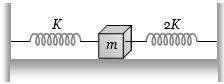
- 5Two springs of force constants $K$ and $2K$ are connected to a mass as shown below. The frequency of oscillation of the mass isView Solution
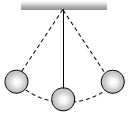
- 6What is the velocity of the bob of a simple pendulum at its mean position, if it is able to rise to vertical height of $10cm$ ......... $m/s$ (Take $g = 9.8\,m/{s^2})$View Solution
- 7A particle executes simple harmonic motion with an amplitude of $4 \,cm$. At the mean position the velocity of the particle is $10\, cm/s$. The distance of the particle from the mean position when its speed becomes $5 \,cm/s$ isView Solution
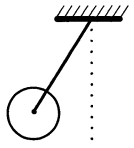
- 8A metal rod of length ' $L$ ' and mass ' $m$ ' is pivoted at one end. A thin disk of mass ' $M$ ' and radius $'R'$ $( < L)$ is attached at its center to the free end of the rod. Consider two ways the disc is attached: (case $A$) The disc is not free to rotate about its center and (case $B$) the disc is free to rotate about its center. The rod-disc system performs $SHM$ in vertical plane after being released from the same displaced position. Which of the following statement$(s)$ is (are) true? $Image$View Solution
$(A)$ Restoring torque in case $A =$ Restoring torque in case $B$
$(B)$ Restoring torque in case $A < $ Restoring torque in case $B$
$(C)$ Angular frequency for case $A > $ Angular frequency for case $B$.
$(D)$ Angular frequency for case $A < $ Angular frequency for case $B$.
- 9The phase (at a time $t$) of a particle in simple harmonic motion tellsView Solution
- 10A particle undergoing simple harmonic motion has time dependent displacement given by $x(t)\, = \,A\,\sin \,\frac{{\pi t}}{{90}}$. The ratio of kinetic to potential energy $o$ the particle at $t=210\,s$ will beView Solution