MCQ
Volume of gas become four times if
  • Temperature become four times at constant pressure
  • B
    Temperature become one fourth at constant pressure
  • C
    Temperature becomes two times at constant pressure
  • D
    Temperature becomes half at constant pressure

Answer

Correct option: A.
Temperature become four times at constant pressure
a
From ideal gas law, $PV = nRT$.

So, to increase the volume by $4$ times, temperature has to be increased by $4$ times at constant pressure.

This option $( A )$ is correct.

Need a full question paper?

Generate a complete, print-ready paper with questions like this in minutes — across 16+ boards, with answer keys.
Start Generating Free

Similar questions

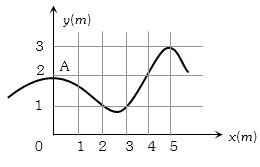
The trajectory of a particle moving in vast maidan is as shown in the figure. The coordinates of a position A are $(0,2)$. The coordinates of another point at which the instantaneous velocity is same as the average velocity between the points are
If the light moving in a straight line bends by a small but fixed angle, it may be a case of:
  1. Reflection.
  2. Refraction.
  3. Diffraction.
  4. Dispersion.
Three containers $\mathrm{C}_{1}, \mathrm{C}_{2}$ and $\mathrm{C}_{3}$ have water at different temperatures. The table below shows the final temperature $T$ when different amounts of water (given in litres) are taken from each containers and mixed (assume no loss of heat during the process)

$\begin{array}{|c|c|c|c|}\hline \mathrm{C_{1 }} & {\mathrm{C}_{2}} & {\mathrm{C}_{3}} & {\mathrm{T}} \\ \hline {1 l} & {2 l} & {-} & {60^{\circ} \mathrm{C}} \\ \hline {-} & {1 l} & {2 l} & {30^{\circ} \mathrm{C}} \\ \hline  {2 l} & {-} & {1 l} & {60^{\circ} \mathrm{C}} \\ \hline  {1 l} & {1 l} & {1 l} & {\theta} \\ \hline\end{array}$

The value of $\theta$ (in $^{\circ} \mathrm{C}$ to the nearest integer) is
Area under a speed - time graph gives:
Two balls in free space are colliding with each other. Which of the following statement regarding linear momentum conservation of the system is true ?
If $\Delta U$ and $\Delta W$ represent the increase in internal energy and work done by the system respectively in a thermodynamical process, which of the following is true?
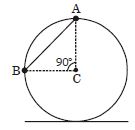
Two beads connected by massless inextensible string are placed over the fixed ring as shown in figure. Mass of each bead is $m$ , and there is no friction between $B$ and ring. Find minimum value of coefficient of friction between $A$ and ring so that system remains in equilibrium. ( $C \to $center of ring, $AC$ line is vertical)
The unit of Young’s modulus is
The pressure and volume of an ideal gas are related as $\mathrm{PV}^{3 / 2}=\mathrm{K}$ (Constant). The work done when the gas is taken from state $A\left(P_1, V_1, T_1\right)$ to state $\mathrm{B}\left(\mathrm{P}_2, \mathrm{~V}_2, \mathrm{~T}_2\right)$ is :
A spherical soap bubble inside an air chamber at pressure $P_0=10^5 Pa$ has a certain radius so that the excess pressure inside the bubble is $\Delta P=144 Pa$. Now, the chamber pressure is reduced to $8 P_0 / 27$ so that the bubble radius and its excess pressure change. In this process, all the temperatures remain unchanged. Assume air to be an ideal gas and the excess pressure $\Delta P$ in both the cases to be much smaller than the chamber pressure. The new excess pressure $\Delta P$ in $Pa$ is