Question
WAP using function to insert new element in sorted list.
Get the step-by-step solution for this question inside the Vidyadip app.
Get the answer in the appGenerate a complete, print-ready paper with questions like this in minutes — across 16+ boards, with answer keys.
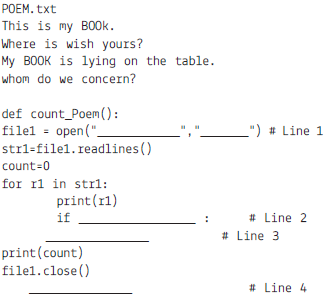
(a) # Line 1 : To open file POEM.txt in read mode
(b) # Line 2 : To check first character of every line is ‘W’ or ‘w’.
(c) # Line 3 : To increase the value of count by 1.
(d) # Line 4 : To call the function count_poem.
Table: DEPT
| DCODE | DEPARTMENT | LOCATION |
| D01 | INFRASTRUCTURE | DELHI |
| D02 | MARKETING | DELHI |
| D03 | MEDIA | MUMBAI |
| D05 | FINANCE | KOLKATA |
| D04 | HUMAN RESOURCE | MUMBAI |
Table: EMPLOYEE
| ENO | NAME | DOJ | DOB | GENDER | DCODE |
| 1001 | George K | 2013-09-02 | 1991-09-01 | MALE | D01 |
| 1002 | Ryma Sen | 2012-12-11 | 1990-12-15 | FEMALE | D03 |
| 1003 | Mohitesh | 2013-02-03 | 1987-09-04 | MALE | D05 |
| 1007 | Anil Jha | 2014-01-17 | 1984-10-19 | MALE | D04 |
| 1004 | Manila Sahai | 2012-12-09 | 1986-11-14 | FEMALE | D01 |
| 1005 | R SAHAY | 2013-11-18 | 1987-03-31 | MALE | D02 |
| 1006 | Jaya Priya | 2014-06-09 | 1985-06-23 | FEMALE | D05 |
Note: DOJ refers to date of joining and DOB refers to date of Birth of employees.
(i) To display Eno, Name, Gender from the table EMPLOYEE in ascending order of Eno.
(ii) To display the Name of all the MALE employees from the table EMPLOYEE.
(iii) To display the Eno and Name of those employees from the table EMPLOYEE who a born between ‘1987‐01‐01 ’and ‘1991‐12‐01 ’.
(iv) To count and display FEMALE employees who have joined after ‘1986‐01‐01 ’.
(v) Select count(*),dcode from employee group by dcode having count(*)>1;
(vi) Select distinct department from dept;
(vii) Select name, department from employee e, dept d where e.dcode=d.dcode and en0 <1003;
(viii) select max(doj), min(dob) from employee;
Write the SQL query questions from (i) to (iv) and write the output of SQL command for questions from (v) to (vii) given below:
| EMPID | FIRST NAME | LAST NAME | ADDRESS | CITY |
| 010 | George | Smith | 83 First Street | Howard |
| 105 | Mary | Jones | 842 Vine Ave. | Losantiville |
| 152 | Sam | Tones | 33 Elm St. | Paris |
| 215 | Sarah | Ackerman | 440 U.S. 110 | Upton |
| 244 | Manila | Sengupta | 24 Friends Street | New Delhi |
| 300 | Robert | Samuel | 9 Fifth Cross | Washington |
| 335 | Henry | Williams | 12 Moore Street | Boston |
| 400 | Rachel | Lee | 121 Harrison St. | New York |
| 441 | Peter | Thompson | 11 Red Road | Paris |
Table: EMPSalary
| EMPID | SALARY | BENEFITS | DESIGNATION |
| 010 | 75000 | 15000 | Manager |
| 105 | 65000 | 15000 | Manager |
| 152 | 80000 | 25000 | Director |
| 215 | 75000 | 12500 | Manager |
| 244 | 50000 | 12000 | Clerk |
| 300 | 45000 | 10000 | Clerk |
| 355 | 40000 | 10000 | Clerk |
| 4000 | 32000 | 7500 | Salesman |
| 441 | 28000 | 7500 | Salesman |
Write the SQL commands for the following :
(i) To show firstname, lastname, address and city of all employees living in paris.
(ii) To display the content of Employees table in ascending order of Firstname.
(iii) To display the firstname,lastname and total salary of all managers from the tables employee and empsalary, where total salary is calculated as
salary+benefits.
(iv) To display the maximum salary among managers and clerks from the table Empsalary.
Give the Output of following SQL commands:
(v) Select firstname, salary from employees, empsalary where designation = ‘Salesman’ and Employees.
empid=Empsalary.empid;
(vi) Select count(distinct designation) from empsalary;
(vii) Select designation, sum(salary) from empsalary group by designation having count(*) >2;

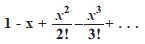
where n and x have to be input from the user. The function should have two parameter n and x and return the sum of the series.
Write the SQL query questions from (i) to (iv) and write the output of SQL command for questions from (v) to (vii) given below:
Table: EMPLOYEES
| EMPID | FIRST NAME | LAST NAME | ADDRESS | CITY |
| 010 | George | Smith |
83 First Street |
Howard |
| 105 | Mary | Jones |
842 Vine Ave. |
Losantiville |
| 152 | Sam | Tones | 33 Elm St. | Paris |
| 215 | Sarah | Ackerman | 440 U.S. 110 | Upton |
| 244 | Manila | Sengupta |
24 Friends Street |
New Delhi |
| 300 | Robert | Samuel | 9 Fifth Cross | Washington |
| 335 | Henry | Williams |
12 Moore Street |
Boston |
| 400 | Rachel | Lee |
121 Harrison St. |
New York |
| 441 | Peter | Thompson | 11 Red Road | Paris |
Table: EMPSALARY
| EMPID | SALARY | BENEFITS | DESIGNATION |
| 010 | 75000 | 15000 | Manager |
| 105 | 65000 | 15000 | Manager |
| 152 | 80000 | 25000 | Director |
| 215 | 75000 | 12500 | Manager |
| 244 | 50000 | 12000 | Clerk |
| 300 | 45000 | 10000 | Clerk |
| 355 | 40000 | 10000 | Clerk |
| 4000 | 32000 | 7500 | Salesman |
| 441 | 28000 | 7500 | Salesman |
Write the SQL commands for the following :
(i) To show firstname, lastname, address and city of all employees living in paris.
(ii) To display the content of Employees table in ascending order of Firstname.
(iii) To display the firstname,lastname and total salary of all managers from the tables employee and empsalary, where total salary is calculated as salary+benefits.
(iv) To display the maximum salary among managers and clerks from the table Empsalary.
Give the Output of following SQL commands:
(v) Select firstname, salary from employees, empsalary where designation = ‘Salesman ’and Employees.
empid=Empsalary.empid;
(vi) Select count(distinct designation) from empsalary;
(vii) Select designation, sum(salary) from empsalary group by designation having count(*) >2;