MCQ
Water falls from a height of $60\, \mathrm{~m}$ at the rate of $15 \,\mathrm{~kg} / \mathrm{s}$ to operate a turbine. The losses due to frictional force are $10\, \%$ of the input energy. How much power is generated by the turbine? $\left(g=10\, \mathrm{~m} / \mathrm{s}^{2}\right)$  (In $\mathrm{~kW}$)
  • A
    $10.2$
  • $8.1$
  • C
    $12.3$
  • D
    $7.0$

Answer

Correct option: B.
$8.1$
b
$\mathrm{E}=\mathrm{mgh}$

$\mathrm{P}_{\text {input }}=\frac{\mathrm{mgh}}{\mathrm{t}}$

$=\frac{15 \times 10 \times 60}{1}=9000=9\, \mathrm{~kW}$

$10 \,\% \operatorname{loss}=0.9 \times 10^{3}$

$\mathrm{P}_{\text {output }}=9 \times 10^{3}-0.9 \times 10^{3}=8.1 \,\mathrm{~kW}$

Need a full question paper?

Generate a complete, print-ready paper with questions like this in minutes — across 16+ boards, with answer keys.

Start Generating Free

Similar questions

Light year is a unit of
A heavy ring of mass m is clamped on the periphery of al light circular disc. A small particle having equal mass is clamped at the centre of the disc. The system is rotated in such a way that the centre moves in a circle of radius r with a uniform speed v. We conclude that an external force:
Reference to ability of an object to return to its original position after it has been tilted slightly is termed as:
An object is moving with a uniform acceleration which is parallel to its instantaneous direction of motion. The displacement $(s) - $ velocity $(v)$ graph of this object is
In $SI\, units$, the dimensions of $\sqrt {\frac{{{ \varepsilon _0}}}{{{\mu _0}}}} $ is
In a thermodynamic process pressure of a fixed mass of a gas is changed in such a manner that the gas releases $30$ joules of heat and $10$ joules of work was done on the gas. If the initial internal energy of the gas was $30$ joules, then the final internal energy will be ........ $J$
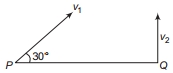
A projectile $A$ is thrown at an angle $30^{\circ}$ to the horizontal from point $P$. At the same time another projectile $B$ is thrown with velocity $v_2$ upwards from the point $Q$ vertically below the highest point $A$ would reach. For $B$ to collide with $A$, the ratio $\frac{v_2}{v_1}$ should be
A thick-walled hollow sphere has outside radius $R_0$. It rolls down an incline without slipping and its speed at the bottom is $v_0$. Now the incline is waxed, so that it is practically frictionless and the sphere is observed to slide down (without any rolling). Its speed at the bottom is observed to be $5{v_0}/4$. The radius of gyration of the hollow sphere about an axis through its centre is
The escape velocity of a body from the earth is $ve.$ If the radius of earth contracts to $\frac{1}{4}^\text{th}$ of its value, keeping the mass of the earth constant, escape velocity will be:
A particle moves so that its position vector is given by $\overrightarrow {\;r} = cos\omega t\,\hat x + sin\omega t\,\hat y$ , where $\omega$ is a constant.  Which of the following is true?