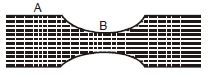
Water flows in a horizontal tube as shown in figure. The pressure of water changes by $600\, N/ m^2$ between $A$ and $B$ where the area of crosssection are $30\, cm^2$ and $15\, cm^2$ respectively. Find the rate of flow of water through the tube.
Diffcult
Download our app for free and get started
$\mathrm{A}_{1} \mathrm{v}_{1}=\mathrm{A}_{2} \mathrm{v}_{2}$
or $\mathrm{v}_{2}=\left(\frac{\mathrm{A}_{1}}{\mathrm{A}_{2}}\right) \mathrm{v}_{1}$ $...(i)$
from bernoulli's equation for horizontal flow,
$\mathrm{P}_{1}+\frac{1}{2} \rho \mathrm{v}_{1}^{2}=\mathrm{P}_{2}+\frac{1}{2} \rho \mathrm{v}_{2}^{2}$
$\mathrm{P}_{1}+\frac{1}{2} \rho \mathrm{v}_{1}^{2}=\mathrm{P}_{2}+\frac{1}{2} \rho\left[\frac{\mathrm{A}_{1}^{2}}{\mathrm{A}_{2}^{2}}\right] \mathrm{v}_{1}^{2}$
or $\mathrm{P}_{1}-\mathrm{P}_{2}=\frac{1}{2} \rho \mathrm{v}_{1}^{2}\left[\frac{\mathrm{A}_{1}^{2}}{\mathrm{A}_{2}^{2}}-1\right]$
but $\mathrm{P}_{1}-\mathrm{P}_{2}=600 \mathrm{N} / \mathrm{m}^{2}$
$600=\frac{1}{2} \rho v_{1}^{2}\left[\frac{A_{1}^{2}}{A_{2}^{2}}-1\right]$
$\mathrm{v}_{1}=\sqrt{\frac{1200}{\rho}}\left[\frac{\mathrm{A}_{1}^{2}}{\mathrm{A}_{2}^{2}}-1\right]^{-1 / 2}$
$\mathrm{Q}=\mathrm{A}_{1} \mathrm{v}_{1}=\mathrm{A}_{2} \mathrm{v}_{2}$
$=\frac{6}{\sqrt{10}} \times 10^{-3} \mathrm{m}^{3} / \mathrm{s}$

Download our appand get started for free
Experience the future of education. Simply download our apps or reach out to us for more information. Let's shape the future of learning together!No signup needed.*
Similar Questions
- 1View SolutionWater falls from a tap, down the streamline
- 2View SolutionAn ice block contains a glass ball when the ice melts within the water containing vessel, the level of water
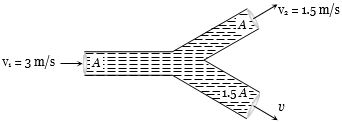
- 3An incompressible liquid flows through a horizontal tube as shown in the following fig. Then the velocity $ v$ of the fluid is .......$m/s$View Solution
- 4In a cylindrical container open to the atmosphere from the top a liquid is filled upto $10\,\, m$ depth. Density of the liquid varies with depth from the surface as $\rho (h) = 100 + 6h^2$ where $h$ is in meter and $\rho$ is in $kg/m^3.$ The pressure at the bottom of the container will be : $($ atmosphere pressure $= 10^5\,\, Pa, \,g = 10\, m/sec^2)$View Solution
- 5A heavy hollow cone of radius $R$ and height $h$ is placed on a horizontal table surface, with its flat base on the table. The whole volume inside the cone is filled with water of density $\rho$ . The circular rim of the cone’s base has a watertight seal with the table’s surface and the top apex of the cone has a small hole. Neglecting atmospheric pressure find the total upward force exerted by water on the cone isView Solution
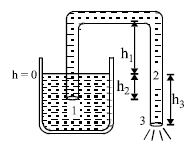
- 6Figure shows a siphon. Choose the wrong statement : ( $P_0 =$ atmospheric pressure)View Solution
- 7The pressure at the bottom of a water tank is $4 P$. where $P$ is atmospheric pressure. If water is drawn out till the water level decreases by $\frac{3}{5}$ th, then pressure at the bottom of the tank is .........View Solution
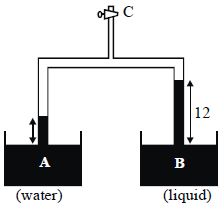
- 8The limbs of a $U$ -tube glass are lowered into vessels $A$ and $B, A$ containing water. Some air is pumped out through the top of the tube $C$. The liquids in the left hand limb $A$ and the right hand limb $B$ rise to heights of $10\, cm$ and $12\, cm$ respectively. The density of liquid $B$ is ........ $g/cm^3$View Solution
- 9View SolutionBernoulli’s principle is based on the law of conservation of
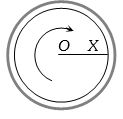
- 10The diagram shows a cup of tea seen from above. The tea has been stirred and is now rotating without turbulence. A graph showing the speed $ v$ with which the liquid is crossing points at a distance $ X$ from $O $ along a radius $XO$ would look likeView Solution