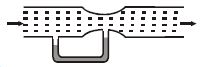
Water flows through the tube shown. Area of cross-section of wide and narrow part are $5$ $cm^2$ $\&$ $2$ $cm^2$. The rate of flow is $500$ $cm^3/sec$. Find difference in mercury level of $U-$ tube .......... $cm$
Diffcult
Download our app for free and get started
$\mathrm{P}_{1}+\frac{1}{2} \rho \mathrm{V}_{2}^{2}=\mathrm{P}_{2}+\frac{1}{2} \rho \mathrm{V}_{2}^{2}$
$\mathrm{P}_{1}-\mathrm{P}_{2}=\frac{1}{2} \rho\left(\mathrm{V}_{2}^{2}-\mathrm{v}_{1}^{2}\right)$
$\mathrm{h} \times 13600 \times \mathrm{g}=\frac{1}{2} \times 1000\left(\mathrm{V}_{2}^{2}-\mathrm{V}_{1}^{2}\right)$
$A_{1} V_{1}=A_{2} V_{2}=\frac{d(\text { volume })}{d t}$
$\mathrm{V}_{1}=\frac{500}{5}=100 \mathrm{cm} / \mathrm{s}=1 \mathrm{m} / \mathrm{s}$
$\mathrm{V}_{2}=\frac{500}{2}=250 \mathrm{cm} / \mathrm{s}=2.5 \mathrm{m} / \mathrm{s}$
$\mathrm{h}=\frac{\frac{1}{2} \times 1000(0.25-1)}{13600 \times 10} \mathrm{m}$
$\mathrm{h}=\frac{1}{2} \times \frac{5.25 \times 100}{136} \mathrm{cm}$

Download our appand get started for free
Experience the future of education. Simply download our apps or reach out to us for more information. Let's shape the future of learning together!No signup needed.*
Similar Questions
- 1A heavy hollow cone of radius $R$ and height $h$ is placed on a horizontal table surface, with its flat base on the table. The whole volume inside the cone is filled with water of density $\rho$ . The circular rim of the cone’s base has a watertight seal with the table’s surface and the top apex of the cone has a small hole. Neglecting atmospheric pressure find the total upward force exerted by water on the cone isView Solution
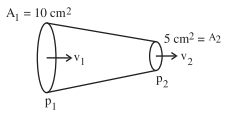
- 2Glycerine of density $1.25 \times 10^3\,kg\,m ^{-3}$ is flowing through the conical section of pipe. The area of cross-section of the pipe at its ends is $10\,cm ^2$ and $5\,cm ^2$ and pressure drop across its length is $3\,Nm ^{-2}$. The rate of flow of glycerine through the pipe is $x \times 10^{-5} m ^3 s ^{-1}$. The value of $x$ is $..............$.View Solution
- 3A liquid of density $750\,kgm ^{-3}$ flows smoothly through a horizontal pipe that tapers in crosssectional area from $A _{1}=1.2 \times 10^{-2}\,m ^{2}$ to $A_{2}=\frac{A_{1}}{2}$. The pressure difference between the wide and narrow sections of the pipe is $4500\,Pa$. The rate of flow of liquid is________$\times 10^{-3}\,m ^{3} s ^{-1}$View Solution
- 4The velocity of water in a river is $18\, km/h$ near the surface. If the river is $5\, m$ deep, find the shearing stress between the horizontal layers of water. The co-efficient of viscosity of water $= 10^{-2}\,,poise$View Solution
- 5A spherical solid ball of volume $V$ is made of a material of density $\rho_1$ . It is falling through a liquid of density $\rho_2 (\rho_2 < \rho_1 )$. Assume that the liquid applies a viscous force on the ball that is proportional to the square of its speed $v$, i.e., $F_{viscous}= -kv^2 (k >0 )$,The terminal speed of the ball isView Solution
- 6The area of cross-section of a large tank is $0.5 \; m ^{2}$. It has a narrow opening near the bottom having area of cross-section $1 \; cm ^{2}$. A load of $25 \; kg$ is applied on the water at the top in the tank. Neglecting the speed of water in the tank, the velocity of the water, coming out of the opening at the time when the height of water level in the tank is $40 \; cm$ above the bottom, will be $\dots \; cms ^{-1}$. $\left[\right.$ Take $\left.g =10 \; ms ^{-2}\right]$View Solution
- 7A silver ingot weighing $2.1 kg$ is held by a string so as to be completely immersed in a liquid of relative density $0.8$. The relative density of silver is $10.5$ . The tension in the string in $kg-wt$ isView Solution
- 8Water is moving with a speed of $5.0\,m/s$ through a pipe of cross sectional area $4.0\,cm^2$ . The water gradually descends $10\,m$ as the pipe increase in area to $8.0\,cm^2$ . If the pressure at the upper level is $1.5 \times 10^5\,Pa$ , the pressure at lower level will beView Solution
- 9A solid sphere of radius $R$ and density $\rho$ is attached to one end of a mass-less spring of force constant $k$. The other end of the spring is connected to another solid sphere of radius $R$ and density $3 p$. The complete arrangement is placed in a liquid of density $2 p$ and is allowed to reach equilibrium. The correct statement$(s)$ is (are)View Solution
$(A)$ the net elongation of the spring is $\frac{4 \pi R^3 \rho g}{3 k}$
$(B)$ the net elongation of the spring is $\frac{8 \pi R^3 \rho g}{3 k}$
$(C)$ the light sphere is partially submerged.
$(D)$ the light sphere is completely submerged.
- 10A vertical U-tube of uniform cross-section contains water in both the arms. A $10 \,cm$ glycerine column ($R.D$. $=1.2$ ) is added to one of the limbs. The level difference between the two free surfaces in the two limbs will be ...... $cm$View Solution