Water from a tap emerges vertically downwards with an initial speed of $1.0\,ms^{-1}.$ The cross-sectional area of the tap is $10^{-4}\,m^2.$ Assume that the pressure is constant throughout the stream of water and that flow is streamlined. The cross-sectional area of the stream, $0.15\,m$ below the tap would be: (take $g = 10\,ms^{-2}$ )
JEE MAIN 2019, Medium
Download our app for free and get started
${10^{ - 4}}\, \times \,1\, = \sqrt {{{(1)}^2} + 2 \times 10 \times 0.15 \times } A$
$A = \frac{{{{10}^{ - 4}}}}{2} = 5 \times {10^{ - 5}}$

Download our appand get started for free
Experience the future of education. Simply download our apps or reach out to us for more information. Let's shape the future of learning together!No signup needed.*
Similar Questions
- 1A small drop of water falls from rest through a large height $h$ in air; the final velocity is ................View Solution
- 2Two drops of same radius are falling through air with steady velocity of $v $ $cm/s$. If the two drops coalesce, what would be the terminal velocity?View Solution
- 3View SolutionWater is flowing through a horizontal pipe of non-uniform cross-section. At the extreme narrow portion of the pipe, the water will have
- 4A tank $5\, m$ high is half-filled with water and then is filled to the top with oil of density $0.85\, g/cm^3$. The pressure at the bottom of the tank, due to these liquids is ....... $g\, dyne/cm^2$View Solution
- 5A body of density $\rho$ is dropped from rest from a height $h$ into a lake of density $\sigma$, where $\sigma > \rho$. Neglecting all dissipative forces, the maximum depth to which the body sinks before returning to float on surface ..........View Solution
- 6A capillary tube is attached horizontally to a constant head arrangement. If the radius of the capillary tube is increased by $10\%$ then the rate of flow of liquid will change nearly by ......... $\%$View Solution
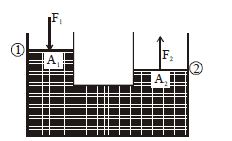
- 7The diagram below shows a hydraulic lift.A force is applied at $side\ 1$ and an output force is generated at $side\ 2$. Which of the following is true?View Solution
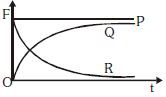
- 8A heavy spherical ball is dropped near surface in a long column of viscous liquid. Which of the following graphs represent the variation ofView Solution
$(i)$ Gravitational force with time
$(ii)$ Viscous force with time
$(iii)$ Net force acting on the ball with time
- 9A sample of metal weighs $210 gm$ in air, $180 gm$ in water and $120 gm$ in liquid. Then relative density $(RD) $ ofView Solution
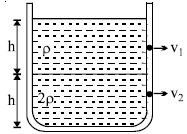
- 10Equal volumes of two immiscible liquids of densities $\rho$ and $2\rho$ are filled in a vessel as shown in figure. Two small holes are punched at depth $h/ 2$ and $3h/2$ from the surface of lighter liquid. If $v_1 $ and $v_2 $ are the velocities of a flux at these two holes, then $v_1/v_2 $ is :View Solution