MCQ
Water has maximum density at
  • A
    $0°C$
  • B
    $32°F$
  • C
    $-4°C$
  • $4°C$

Answer

Correct option: D.
$4°C$
d
(d) Water has maximum density at $4°C.$

Need a full question paper?

Generate a complete, print-ready paper with questions like this in minutes — across 16+ boards, with answer keys.
Start Generating Free

Similar questions

While travelling from one station to another, a car travels $75 \,km$ North, $60\, km$ North-east and $20 \,km $ East. The minimum distance between the two stations is.......$km$
The threshold wavelength for photoelectric effect of a metal is $6500 Å$. The work function of the metal is approximately .......... $eV$
$X-$ rays are produced by accelerating electrons by voltage $V$ and let they strike a metal of atomic number $Z$. The highest frequency of $X-$ rays produced is proportional to
Your friend driving his car overtakes your car on the highway. Which of the following statement must be true at the instant he is passing you? Assume the cars as point particles.
One mole of ideal monoatomic gas $(\gamma = 5/3)$ is mixed with one mole of diatomic gas $(\gamma = 7/5).$ What is $\gamma $ for the mixture$?$ $\gamma $ denotes the ratio of specific heat at constant pressure, to that at constant volume
Which of the following statement is false for the properties of electromagnetic waves ?
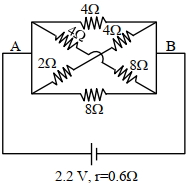
In the given figure, the $emf$ of the cell is $2.2\, {V}$ and if internal resistance is $0.6\, \Omega$. Calculate the power dissipated in the whole circuit: (in $W$)
With the rise in temperature, the dielectric constant $K$ of a liquid
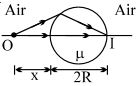
The figure, shows a transparent sphere of radius $R$ and refractive index $\mu$ . An object $O$ is placed at a distance $x$ from the pole of the first surface so that a real image is formed at the pole of the exactly opposite surface. In previous problem, if the refractive index of the sphere is varied, then the position $x$ of the object and its image from the respective poles will also vary. Identify the correct statement.
A particle executes simple harmonic motion. Its amplitude is $8 \,cm$ and time period is $6 \,s$. The time it will take to travel from its position of maximum displacement to the point corresponding to half of its amplitude, is ............. $s$