Water is flowing in a pipe of diameter $ 4 cm$ with a velocity $3 m/s. $ The water then enters into a tube of diameter $ 2 cm.$ The velocity of water in the other pipe is .......... $m/s$
Medium
Download our app for free and get started
(c)${a_1}{v_1} = {a_2}{v_2}$ ==> $\frac{{{v_2}}}{{{v_1}}} = \frac{{{a_1}}}{{{a_2}}} = {\left( {\frac{{{r_1}}}{{{r_2}}}} \right)^2}$
==> ${v_2} = 3 \times {(2)^2}$ $= 12 m/s$
==> ${v_2} = 3 \times {(2)^2}$ $= 12 m/s$

Download our appand get started for free
Experience the future of education. Simply download our apps or reach out to us for more information. Let's shape the future of learning together!No signup needed.*
Similar Questions
- 1A cylindrical tank has a hole of $1 cm^2$ in its bottom. If the water is allowed to flow into the tank from a tube above it at the rate of $70 cm^3/sec$. then the maximum height up to which water can rise in the tank is .......... $cm$View Solution
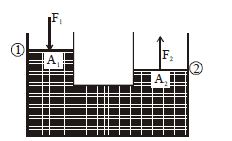
- 2The diagram below shows a hydraulic lift.A force is applied at $side\ 1$ and an output force is generated at $side\ 2$. Which of the following is true?View Solution
- 3View SolutionThe height to which a cylindrical vessel be filled with a homogeneous liquid, to make the average force with which the liquid presses the side of the vessel equal to the force exerted by the liquid on the bottom of the vessel, is equal to
- 4Water is flowing with a velocity of $2\,m/s$ in a horizontal pipe where cross-sectional area is $2 \times 10^{-2}\, m^2$ at pressure $4 \times 10^4\, pascal$. The pressure at cross-section of area $0.01\, m^2$ in pascal will beView Solution
- 5An open $U$-tube contains mercury. When $13.6 \,cm$ of water is poured into one of the arms of the tube, then the mercury rise in the other arm from its initial level is ....... $cm$View Solution
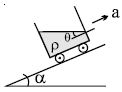
- 6A fluid container is containing a liquid of density $\rho $ is accelerating upward with acceleration a along the inclined place of inclination $\alpha$ as shown. Then the angle of inclination $ \theta $ of free surface is :View Solution
- 7A spring balance reads $200 \,gF$ when carrying a lump of lead in air. If the lead is now immersed with half of its volume in brine solution, what will be the new reading of the spring balance? specific gravity of lead and brine are $11.4$ and $1.1$ respectively ........... $gF$View Solution
- 8View SolutionIn a turbulent flow, the velocity of the liquid molecules in contact with the walls of the tube is
- 9Force in Column - $\mathrm{I}$ and its use is in Column - $\mathrm{II}$ are given. Match them appropriately.View Solution
Column - $\mathrm{I}$ Column - $\mathrm{II}$ $(a)$ Cohesive force $(i)$ Useful for writing by chalk on blackboard. $(b)$ Adhesive force $(ii)$ Useful in soldering. $(iii)$Useful for formation of spherical drops of liquid. - 10View SolutionA good lubricant should have