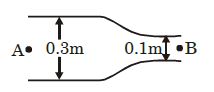
Water is flowing through a horizontal tube according to the figure. Its diameter at two points are $0.3\,m$ and $0.1\,m$ respectively. Pressure difference between these two points is equal to $0.8\,m$ of water column. Find rate of flow of water in the tube ..... $ltr/s$
, Advanced
Download our app for free and get started
According to Bernoulli's thereom
$\mathrm{P}_{1}+\frac{1}{2} \rho \mathrm{v}_{1}^{2}=\mathrm{P}_{2}+\frac{1}{2} \rho \mathrm{v}_{2}^{2}$
$\Rightarrow P_{1}-P_{2}=\frac{1}{2} \rho\left[v_{2}^{2}-v_{1}^{2}\right]$
Let rate of flow $Q=A_{1} v_{1}=A_{2} v_{2}$
$\mathrm{h} \rho \mathrm{g}=\frac{1}{2} \rho\left[\frac{\mathrm{Q}^{2}}{\mathrm{A}_{2}^{2}}-\frac{\mathrm{Q}^{2}}{\mathrm{A}_{1}^{2}}\right]$
$\Rightarrow 2 g h=Q^{2}\left[\frac{A_{1}^{2}-A_{2}^{2}}{A_{1}^{2} A_{2}^{2}}\right]$
$\Rightarrow Q=\sqrt{\frac{2 g h A_{1}^{2} A_{2}^{2}}{A_{1}^{2}-A_{2}^{2}}}$
$Q=A_{1} A_{2} \sqrt{\frac{2 g h}{A_{1}^{2}-A_{2}^{2}}}$
$=\pi r_{1}^{2} \times \pi r_{2}^{2} \sqrt{\frac{2 \times 10 \times 0.8}{\left(\pi r_{1}^{2}\right)^{2}-\left(\pi r_{2}^{2}\right)^{2}}}$
$=\frac{\pi^{2} r_{1}^{2} r_{2}^{2}}{\pi} \sqrt{\frac{16}{\left(225 \times 10^{-4}\right)^{2}-\left(25 \times 10^{-4}\right)^{2}}}$
$=\frac{10 \times 225 \times 10^{-4} \times 25 \times 10^{-4} \times 4}{\pi \times 10^{-4} \sqrt{250 \times 200}}$
$=\frac{225 \times 25 \times 4 \times 10^{-3}}{\pi \times 10^{2} \sqrt{5}}$
$=\frac{45 \sqrt{5}}{\pi} \times 10^{-5} \mathrm{m}^{5} / \mathrm{s}=32 \mathrm{ltr} / \mathrm{s}$

Download our appand get started for free
Experience the future of education. Simply download our apps or reach out to us for more information. Let's shape the future of learning together!No signup needed.*
Similar Questions
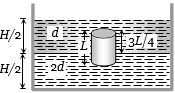
- 1A homogeneous solid cylinder of length $L$$(L < H/2)$. Cross-sectional area $A/5$ is immersed such that it floats with its axis vertical at the liquid-liquid interface with length $L/4$ in the denser liquid as shown in the fig. The lower density liquid is open to atmosphere having pressure ${P_0}$. Then density $D$ of solid is given byView Solution
- 2$Assertion :$ A bubble comes from the bottom of a lake to the top.View Solution
$Reason :$ Its radius increases. - 3View SolutionAn ice cube contains a large air bubble. The cube is floating on the horizontal surface of water contained in a trough. What will happen to the water level, when the cube melts?
- 4A $U-$tube contains water and methylated spirit separated by mercury. The mercury columns in the two arms are in level with $10.0\; cm$ of water in one arm and $12.5\; cm $ of spirit in the other. if $15.0\; cm$ of water and spirit each are further poured into the respective arms of the tube, what is the difference in the levels (in $cm$) of mercury in the two arms?View Solution
(the specific gravity of spirit is $0.8.)$
- 5A hydraulic automobile lift is designed to lift cars with a maximum mass of $3000\, kg$. The area of cross section a of piston carrying the load is $425\, cm ^{2}$. What is the maximum pressure () would smaller piston have to bear ?View Solution
- 6A tank $5 \,m$ high is half filled with water and then is filled to the top with oil of density $0.85 \,g/cm^3$. The pressure at the bottom of the tank, due to these liquids is ........ $g/cm^2$View Solution
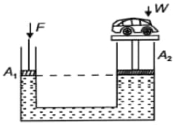
- 7In a hydraulic jack as shown, mass of the car $W=800 \,kg , A_1=10 \,cm ^2, A_2=10 \,m ^2$. The minimum force $F$ required to lift the car is ........... $N$View Solution
- 8A cubical block of steel of each side equal to $l$ is floating on mercury in a vessel. The densities of steel and mercury ar $\rho _s$ and $\rho _m$ . The height of the block above the mercury level is given byView Solution
- 9View SolutionWater flows out of the hole on the side of a bucket and follows a parabolic path. If the bucket falls freely under gravity, ignoring air resistance, the water flow
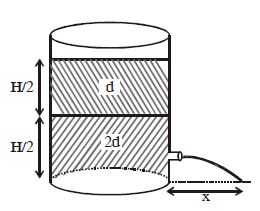
- 10A container of large uniform cross-sectional area $A$ is resting on a horizontal surface holds two immiscible, non-viscous and incompressible liquids of densities $d$ and $2d$ each of height $\frac{H}{2}$ as shown. The lower density of liquid is open to atmosphere. A small hole is made on the wall of container at height $h\left( {h < \frac{H}{2}} \right)$. The initial speed of efflux of the liquid at the hole isView Solution