MCQ
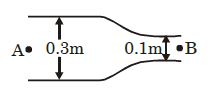
Water is flowing through a horizontal tube according to the figure. Its diameter at two points are $0.3\,m$ and $0.1\,m$  respectively. Pressure difference between these two points is equal to $0.8\,m$ of water column. Find rate of flow of water in the tube ..... $ltr/s$
  • $32$
  • B
    $72$
  • C
    $198$
  • D
    $49.5$

Answer

Correct option: A.
$32$
a
According to Bernoulli's thereom

$\mathrm{P}_{1}+\frac{1}{2} \rho \mathrm{v}_{1}^{2}=\mathrm{P}_{2}+\frac{1}{2} \rho \mathrm{v}_{2}^{2}$

$\Rightarrow P_{1}-P_{2}=\frac{1}{2} \rho\left[v_{2}^{2}-v_{1}^{2}\right]$

Let rate of flow $Q=A_{1} v_{1}=A_{2} v_{2}$

$\mathrm{h} \rho \mathrm{g}=\frac{1}{2} \rho\left[\frac{\mathrm{Q}^{2}}{\mathrm{A}_{2}^{2}}-\frac{\mathrm{Q}^{2}}{\mathrm{A}_{1}^{2}}\right]$

$\Rightarrow 2 g h=Q^{2}\left[\frac{A_{1}^{2}-A_{2}^{2}}{A_{1}^{2} A_{2}^{2}}\right]$

$\Rightarrow Q=\sqrt{\frac{2 g h A_{1}^{2} A_{2}^{2}}{A_{1}^{2}-A_{2}^{2}}}$

$Q=A_{1} A_{2} \sqrt{\frac{2 g h}{A_{1}^{2}-A_{2}^{2}}}$

$=\pi r_{1}^{2} \times \pi r_{2}^{2} \sqrt{\frac{2 \times 10 \times 0.8}{\left(\pi r_{1}^{2}\right)^{2}-\left(\pi r_{2}^{2}\right)^{2}}}$

$=\frac{\pi^{2} r_{1}^{2} r_{2}^{2}}{\pi} \sqrt{\frac{16}{\left(225 \times 10^{-4}\right)^{2}-\left(25 \times 10^{-4}\right)^{2}}}$

$=\frac{10 \times 225 \times 10^{-4} \times 25 \times 10^{-4} \times 4}{\pi \times 10^{-4} \sqrt{250 \times 200}}$

$=\frac{225 \times 25 \times 4 \times 10^{-3}}{\pi \times 10^{2} \sqrt{5}}$

$=\frac{45 \sqrt{5}}{\pi} \times 10^{-5} \mathrm{m}^{5} / \mathrm{s}=32 \mathrm{ltr} / \mathrm{s}$
Need a full question paper?

Generate a complete, print-ready paper with questions like this in minutes — across 16+ boards, with answer keys.

Start Generating Free

Similar questions

A couple produces a:
In one metre long open pipe what is the harmonic of resonance obtained with a tuning fork of frequency $480 Hz$
A water drop of radius $1\,cm$ is broken into $729$ equal droplets. If surface tension of water is $75\,dyne / cm$, then the gain in surface energy upto first decimal place will be$...\times 10^{-4}\,J$
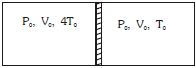
Figure shows a cylindrical adiabatic container of total volume $2V_0$ divided into two equal parts by a conducting piston (which is free to move). Each part containing identical gas at pressure $P_0$ . Initially temperature of left and right part is $4T_0$ and $T_0$ respectively. An external force is applied on the piston to keep the piston at rest. Find the value of external force required when thermal equilibrium is reached. ( $A =$ Area of piston)
If $x = at + b{t^2}$, where $x$ is the distance travelled by the body in kilometres while $t$ is the time in seconds, then the units of $b$ are
A body of $5 \,kg$ is moving with a velocity of $20 \,m/s$. If a force of $100\,N$ is applied on it for $10\,s$ in the same direction as its velocity, what will now be the velocity of the body.........$m/s$
The internal energy of an ideal gas depends on:
Two masses $m_1\, \& m_2$ are initially at rest and are separated by a very large distance. If the masses approach each other subsequently, due to gravitational attraction between them, their relative velocity of approach at a separation distance of $d$ is :
If temperature of an object is $140°F$, then its temperature in centigrade is........ $^oC$
A force $F = (5\hat i + 3\hat j)$ newton is applied over a particle which displaces it from its origin to the point $r = (2\hat i - 1\hat j)$ metres. The work done on the particle is....$joules$