Water is flowing through a tube of non-uniform cross-section ratio of the radius at entry and exit end of the pipe is $ 3 : 2.$ Then the ratio of velocities at entry and exit of liquid is
Medium
Download our app for free and get started
(a) If velocities of water at entry and exit points are $v_1 and v_2$, then according to equation of continuity,
${A_1}{v_1} = {A_2}{v_2}$==> $\frac{{{v_1}}}{{{v_2}}} = \frac{{{A_2}}}{{{A_1}}} = {\left( {\frac{{{r_2}}}{{{r_1}}}} \right)^2} = {\left( {\frac{2}{3}} \right)^2} = \frac{4}{9}$
${A_1}{v_1} = {A_2}{v_2}$==> $\frac{{{v_1}}}{{{v_2}}} = \frac{{{A_2}}}{{{A_1}}} = {\left( {\frac{{{r_2}}}{{{r_1}}}} \right)^2} = {\left( {\frac{2}{3}} \right)^2} = \frac{4}{9}$

Download our appand get started for free
Experience the future of education. Simply download our apps or reach out to us for more information. Let's shape the future of learning together!No signup needed.*
Similar Questions
- 1An inverted tube barometer is kept on a lift with a moving downward with a deceleration $\alpha $ . The density of mercury is $\rho$ and acceleration due to gravity is $g$ . If the atmospheric pressure be $P_0$ thenView Solution
- 2View SolutionA block of ice floats in an oil in a vessel when the ice melts, the level of oil will ..............
- 3A uniform solid cylinder of density $0.8$ $g/cm^3$ floats in equilibrium in a combination of two non-mixing liquid $A$ and $B$ with its axis vertical. The densities of liquid $A$ and $B$ are $0.7$ $g/cm^3$ and $1.2$ $gm/cm^3$. The height of liquid $A$ is $h_A = 1.2$ $cm$ and the length of the part of cylinder immersed in liquid $B$ is $h_B = 0.8$ $cm$. Then the length part of the cylinder in air is ....... $cm$View Solution
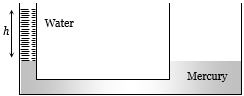
- 4Two communicating vessels contain mercury. The diameter of one vessel is $n$ times larger than the diameter of the other. A column of water of height $ h$ is poured into the left vessel. The mercury level will rise in the right-hand vessel ($s =$ relative density of mercury and $\rho = $ density of water) byView Solution
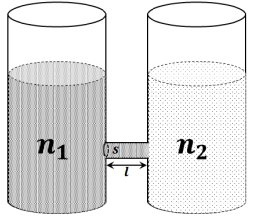
- 5As shown schematically in the figure, two vessels contain water solutions (at temperature $T$ ) of potassium permanganate $\left( KMnO _4\right)$ of different concentrations $n_1$ and $n_2\left(n_1>n_2\right)$ molecules per unit volume with $\Delta n=\left(n_1-n_2\right) \ll n_1$. When they are connected by a tube of small length $\ell$ and cross-sectional area $S , KMnO _4$ starts to diffuse from the left to the right vessel through the tube. Consider the collection of molecules to behave as dilute ideal gases and the difference in their partial pressure in the two vessels causing the diffusion. The speed $v$ of the molecules is limited by the viscous force $-\beta v$ on each molecule, where $\beta$ is a constant. Neglecting all terms of the order $(\Delta n)^2$, which of the following is/are correct? ( $k_B$ is the Boltzmann constant)-View Solution
$(A)$ the force causing the molecules to move across the tube is $\Delta n k_B T S$
$(B)$ force balance implies $n_1 \beta v \ell=\Delta n k_B T$
$(C)$ total number of molecules going across the tube per sec is $\left(\frac{\Delta n}{\ell}\right)\left(\frac{k_B T}{\beta}\right) S$
$(D)$ rate of molecules getting transferred through the tube does not change with time
- 6A fluid is flowing through a horizontal pipe of varying cross-section, with speed $v\;ms^{-1}$ at a point where the pressure is $P$ Pascal. At another point where pressure is $\frac{ P }{2}$ Pascal its speed is $V\;ms^{-1}$. If the density of the fluid is $\rho\, kg\, m ^{-3}$ and the flow is streamline, then $V$ is equal toView Solution
- 7View SolutionThe weight of an aeroplane flying in the air is balanced by
- 8A liquid drop of mass $m$ and radius $r$ is falling from great height. Its velocity is proportional to ............View Solution
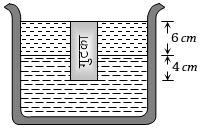
- 9A cubical block of wood $10 \,cm$ on a side floats at the interface between oil and water with its lower surface horizontal and $4\, cm$ below the interface. The density of oil is $0.6gc{m^{ - 3}}$. The mass of block is ...... $gm$View Solution
- 10$Assertion :$ A thin stainless steel needle can lay floating on a still water surface.View Solution
$Reason :$ Any object floats when the buoyancy force balances the weight of the object