A block of ice floats in an oil in a vessel when the ice melts, the level of oil will ..............
Easy


Download our appand get started for free
Experience the future of education. Simply download our apps or reach out to us for more information. Let's shape the future of learning together!No signup needed.*
Similar Questions
- 1The two thigh bones (femures), each of cross-sectional area $10 \,cm ^2$ support the upper part of a person of mass $50 \,kg$. The average pressure sustained by the femures is ............. $N / m ^2$View Solution
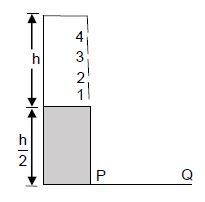
- 2A cylinder of height $h$ is filled with water and is kept on a block of height $h / 2$ . The level of water in the cylinder is kept constant. Four holes numbered $1, 2, 3$ and $4$ are at the side of the cylinder and at heights $0,\ h / 4,\ h / 2$ and $3h / 4$ respectively. When all four holes are opened together, the hole from which water will reach farthest distance on the plane $PQ$ is the hole numberView Solution
- 3Fountains usually seen in gardens are generated by a wide pipe with an enclosure at one end having many small holes. Consider one such fountain which is produced by a pipe of internal diameter $2$ $cm$ in which water flows at a rate $3$ $ms^{^{-1}}$. The enclosure has $100$ holes each of diameter $0.05$ $cm$. The velocity of water coming out of the holes ids ( in $ms^{^{-1}}$)View Solution
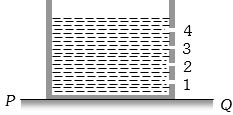
- 4A cylindrical vessel of $90 cm$ height is kept filled upto the brim. It has four holes $ 1, 2, 3, 4$ which are respectively at heights of $20 cm, 30 cm, 45 cm $ and $50 cm$ from the horizontal floor $PQ.$ The water falling at the maximum horizontal distance from the vessel comes fromView Solution
- 5If velocity of flow is $4 \,m / s$, then velocity head is .........$m$View Solution
- 6A cubical block of wood of edge $10$ $cm$ and mass $0.92$ $kg$ floats on a tank of water with oil of rel. density $0.6$ to a depth of $4$ $cm$ above water. When the block attains equilibrium with four of its sides edges verticalView Solution
- 7A liquid drop of mass $m$ and radius $r$ is falling from great height. Its velocity is proportional to ............View Solution
- 8A hosepipe directs a horizontal jet of water moving with velocity of $20\, m/s$ on a vertical wall. The cross-sectional area of jet is $10^{-3}\,m^2$. If density of water is $1000\, kg/m^3$, then force acting on wall is ........... $N$ [Assuming water comes to rest after striking wall]View Solution
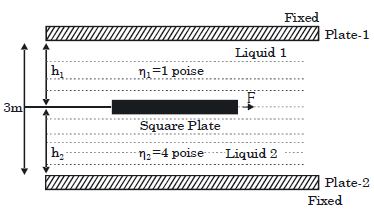
- 9A thin square plate of side $2\ m$ is moving at the interface of two very viscous liquids of viscosities ${\eta _1} = 1$ poise and ${\eta _2} = 4$ poise respectively as shown in the figure. Assume a linear velocity distribution in each fluid. The liquids are contained between two fixed plates. $h_1 + h_2 = 3\ m$ . A force $F$ is required to move the square plate with uniform velocity $10\ m/s$ horizontally then the value of minimum applied force will be ........ $N$View Solution
- 10A sample of metal weighs $210 gm$ in air, $180 gm$ in water and $120 gm$ in liquid. Then relative density $(RD) $ ofView Solution