MCQ
Water rise in a capillary upto an extension height such that upward force of surface tension balances the force of $75 \times 10^{-4}\,N$ due to weight of water. If surface tension of water is $12 \times 10^{-2}\,N/m$. The internal circumference of the capillary must be
  • A
    $12.5 \times 10^{-2}\,m$
  • B
    $6.5 \times 10^{-2}\,m$
  • C
    $1.25 \times 10^{-2}\,m$
  • $6.25 \times 10^{-2}\,m$

Answer

Correct option: D.
$6.25 \times 10^{-2}\,m$
d
$\mathrm{T}(2 \pi \mathrm{r})=$ weight

$\Rightarrow 2 \pi r=\frac{75 \times 10^{-4}}{12 \times 10^{-2}}=6.25 \times 10^{-2} \mathrm{m}$

Need a full question paper?

Generate a complete, print-ready paper with questions like this in minutes — across 16+ boards, with answer keys.

Start Generating Free

Similar questions

Consider a point $P$ on the circumference of a disc rolling along a horizontal surface. If $R$ is the radius of the disc, the distance through which $P$ moves in one full rotation of the disc is
According to the theorem of parallel axes $I = {I_g} + M{d^2}$, the graph between $I$ and $d$ will be
Acceleration due to gravity is$ ‘g’ $on the surface of the earth. The value of acceleration due to gravity at a height of $32\, km$ above earth’s surface is ........ $g$. (Radius of the earth$ = 6400 \,km$)
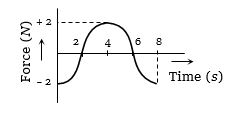
The force-time $(F -t) $ curve of a particle executing linear motion is as shown in the figure. The momentum acquired by the particle in time interval from zero to $8$ second will be  ........... $N-s$
If a cycle wheel of radius $4 \,m$ completes one revolution in two seconds. Then acceleration of a point on the cycle wheel will be
If the value of g at the surface of the earth is $9.8$ $m/{\sec ^2}$, then the value of g at a place $480\, km$ above the surface of the earth will be .......... $m/{\sec ^2}$. (Radius of the earth is $6400\, km$)   
A block of base $10 \mathrm{~cm} \times 10 \mathrm{~cm}$ and height $15 \mathrm{~cm}$ is kept on an inclined plane. The coefficient of friction between them is $\sqrt{3}$. The inclination $\theta$ of this inclined plane from the horizontal plane is gradually increased from $0^{\circ}$. Then
Let $V$ and $E$ denote the gravitational potential and gravitational field at a point. It is possible to have:
  1. $V = 0$ and $E = 0$
  2. $V = 0$ and $E \neq 0$
  3. $V \neq 0$ and $E = 0$
  4. $V \neq 0$ and $E \neq 0$
The $\text{COM}$ of body in pure rotation does-
Two identical objects $A$ and $B$ are at temperatures $T_A$ and $T_B$ respectively. Both objects are placed in a room with perfectly absorbing walls maintained at temperatures T $({T_A} > T > {T_B}).$ The objects A and B attain temperature $T $ eventually which one of the following is correct statement