MCQ
Water stored in a dam possesses:
  • A
    No energy.
  • B
    Electrical energy.
  • C
    Kinetic energy.
  • Potential energy.

Answer

Correct option: D.
Potential energy.
The potential energy possessed by the object is the energy present in it by virtue of its position or configuration. Water stored in a dam, when allowed to flow, has kinetic energy which was earlier stored as potential energy.

Need a full question paper?

Generate a complete, print-ready paper with questions like this in minutes — across 16+ boards, with answer keys.
Start Generating Free

Similar questions

A body weighs $72\; N$ on the surface of the earth. What is the gravitational force on it, at a height equal to half the radius of the earth ?
If the velocity of an object is doubled then its kinetic energy:
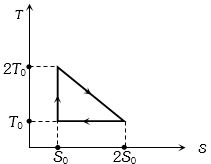
The temperature-entropy diagram of a reversible engine cycle is given in the figure. Its efficiency is
Two pendulums differ in lengths by $22\,cm$ . They oscillate at the same place such that one of them makes $15\,oscillations$ and the other makes $18\,oscillations$ during the same time. The lengths (in $cm$ ) of the pendulums are 
The relationship between Young's modulus $Y,$ Bulk modulus $K$ and modulus of rigidity $\eta $ is
Which of the following doesn't represent rotatory motion?
A ball of mass $0.1\, Kg$. is whirled in a horizontal circle of radius $1\, m$. by means of a string at an initial speed of $10\, R.P.M.$ Keeping the radius constant, the tension in the string is reduced to one quarter of its initial value. The new speed is ....... $r.p.m.$
A box filled with water has a small hole on its side near the bottom. It is dropped from the top of a tower. As it falls, a camera attached on the side of the box records the shape of the water stream coming out of the hole. The resulting video will show
The contact force exerted by a body $A$ on another body $B$ is equal to the normal force between the bodies. We conclude that:
  1. The surfaces must be frictionless.
  2. The force of friction between the bodies is zero.
  3. The magnitude of normal force equals that of friction.
  4. The bodies may be rough but they don't slip on each other.
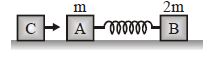
Two bodies $A$ and $B$ of masses $m$ and $2m$ respectively are placed on a smooth floor. They are connected by a spring. A third body $C$ of mass $m$ moves with velocity $V_0$ along the line joining $A$ and $B$ and collides elastically with $A$ as shown in fig. At a certain instant of time $t_0$ after collision, it is found that instantaneous velocities of $A$ and $B$ are the same. Further at this instant the compression of the spring is found to be $x_0$. Determine the spring constant