MCQ
Water waves are
  • A
    Longitudinal
  • B
    Transverse
  • Both longitudinal and transverse
  • D
    Neither longitudinal nor transverse

Answer

Correct option: C.
Both longitudinal and transverse
c
(c)Water waves are transverse as well as longitudinal in nature.

Need a full question paper?

Generate a complete, print-ready paper with questions like this in minutes — across 16+ boards, with answer keys.

Start Generating Free

Similar questions

Two charges each of magnitude $0.01\,C$ and separated by a distance of $0.4\,mm$ constitute an electric dipole. If the dipole is placed in an uniform electric field ' $\vec{E}$ ' of $10\,dyne/C$ making $30^{\circ}$ angle with $\overrightarrow{ E }$, the magnitude of torque acting on dipole is :
The angular speed of a fly wheel moving with uniform angular acceleration changes from $1200\,rpm$ to $3120\,rpm$ in $16$ seconds. The angular acceleration in $rad/s^{2}$ is :
A string fixed at both ends resonates at a certain fundamental frequency. Which of the following adjustments would not affect the fundamental frequency?
Assertion : In a simple battery circuit, the point of the lowest potential is positive terminal of the battery.

Reason : The current flows towards the point of the higher potential, as it does in such a circuit from the negative to the positive terminal.
A curve between magnetic moment and temperature of magnet is
A polyatomic gas $\left( {\gamma = \frac{4}{3}} \right)$ is compressed to $\frac{1}{8}$ of its volume adiabatically. If its initial pressure is ${P_o}$, its new pressure will be
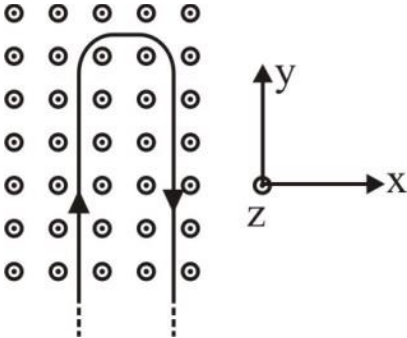
A rigid wire consists of a semicircular portion of radius R and two straight sections. The wire is partially immerged in a perpendicular magnetic field $B=B_0 \hat{j}$as shown in figure. The magnetic force on the wire if it has a current i is :

Image
A car starts from rest and moves with uniform acceleration $'a'$ on a straight road from time $t = 0$ to $t = T$ . After that, a constant deceleration $'a'$ brings it to rest. In this process the average speed of the car is
Check up the only correct statement in the following :-
In a young double slit experiment $D$ equals the distance of screen and $d$ is the separation between the slit. The distance of the nearest point to the central maximum where the intensity is same as that due to a single slit, is equal to