MCQ
Water waves produced by a motor boat sailing in water are:
  • A
    Neither longitudinal nor transverse.
  • Both longitudinal and transverse.
  • C
    Only longitudinal.
  • D
    Only transverse.

Answer

Correct option: B.
Both longitudinal and transverse.
As the waves are produced by motor boat on surface as well as inside water, the waves are both, transverse as well as longitudinal.

Need a full question paper?

Generate a complete, print-ready paper with questions like this in minutes — across 16+ boards, with answer keys.

Start Generating Free

Similar questions

The force is given in terms of time $t$ and displacement $x$ by the equation

${F}={A} \cos {Bx}+{C} \sin {Dt}$

The dimensional formula of $\frac{{AD}}{{B}}$ is -
A ball is projected from ground with a speed of $20\,m / s$ at an angle of $45^{\circ}$ with horizontal. There is a wall of $25\,m$ height at a distance of $10\,m$ from the projection point. The ball will hit the wall at a height of $.........\,m$
$1$ mole of gas occupies a volume of $100\, ml$ at $50\, mm$ pressure. What is the volume occupied by two moles of gas at $100\, mm$ pressure and at same temperature ..... $ml$
A $60\, kg$ body is pushed with just enough force to start it moving across a floor and the same force continues to act afterwards. The coefficient of static friction and sliding friction are $0.5$ and $0.4$ respectively. The acceleration of the body is  ........ $m/{s^2}$
A point source emits sound equally in all directions in a non-absorbing medium. Two points P and Qare at distances of 2 m and 3 m respectively from the source. The ratio of the intensities of the waves at P and Q is:
Consider the following two statements regarding a linearly polarised, plane electromagnetic wave:
  1. The electric field and the magnetic field have equal average values.
  2. The electric energy and the magnetic energy have equal average values.
If a body completes one revolution in $\pi $ $sec$ then the moment of inertia would be
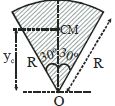
Sector of a circular plate shown in figure has position of centre of mass at $y_{CM} =$
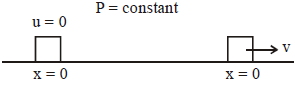
A body of mass $2\, kg$ is driven by an engine delivering a constant power $1\, J / s$. The body starts from rest and moves in a straight line. After $9$ seconds, the body has moved a distance (in $m )$
The spiders and insects move and run about on the surface of water without sinking because