MCQ
Wave which cannot travel in vacuum is
  • A
    $X$$-$ rays
  • Infrasonic
  • C
    Ultraviolet
  • D
    Radiowaves

Answer

Correct option: B.
Infrasonic
b
(b) Infrasonic waves are mechanical waves.

Need a full question paper?

Generate a complete, print-ready paper with questions like this in minutes — across 16+ boards, with answer keys.
Start Generating Free

Similar questions

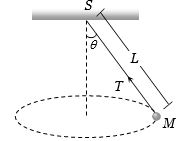
A string of length $L$ is fixed at one end and carries a mass $M$ at the other end. The string makes $2/\pi$ revolutions per second around the vertical axis through the fixed end as shown in the figure, then tension in the string is
An alpha nucleus of energy $\frac{1}{2}mv^2$ bombards a heavy nuclear target of charge $Ze.$ Then the distance of closest approach for the alpha nucleus will be proportional to
The current flowing in two coaxial coils in the same direction. On increasing the distance between the two, the electric current will
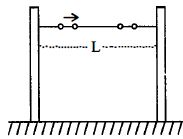
A large number $(n)$ of identical beads, each of mass $m$ and radius $r$ are strung on a thin smooth rigid horizontal rod of length $L\, (L >> r)$ and are at rest at random positions. The rod is mounted between two rigid supports (see figure) . If one of the beads is now given a speed $v$, the average force experienced by each support after a long time is (assume all collisions are elastic)
A projectile is thrown with a velocity of $50\,\, ms^{^{-1}}$ at an angle of $53^o$ with the horizontal Determine the instants at which the projectile is at the same height
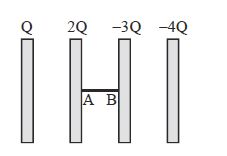
Four very large metal plates are given the charges as shown in figure. The middle two are then connected through a wire. Find the charge that will flow through the wire
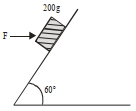
A block of mass $200\, g$ is kept stationary on a smooth inclined plane by applying a minimum horizontal force $F =\sqrt{ x }N$ as shown in figure. The value of $x =.....$
A black body radiates at the rate of $W$ watts at a temperature $T$ . If the temperature of the body is reduced to $T/3$ , it will radiate at the rate of (in Watts)
Given below are two statements : one is labelled as Assertion $A$ and the other is labelled as Reason $R$.

Assertion $A$ : When a body is projected at an angle $45^{\circ}$, it's range is maximum.

Reason $R$ : For maximum range, the value of $\sin 2 \theta$ should be equal to one.

In the light of the above statements, choose the correct answer from the options given below :

The radius of gyration of a disc of mass $50\,g$ and radius $2.5\,cm$ , about an axis passing through its centre of gravity and perpendicular to the plane, is ....... $cm$.