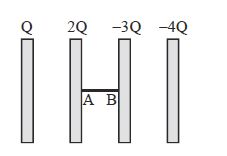
Four very large metal plates are given the charges as shown in figure. The middle two are then connected through a wire. Find the charge that will flow through the wire
Medium
Download our app for free and get started
Distribution of charge before the wire is connected is shown in figure.
On connecting will wire $5 \mathrm{Q}$ and $-5 \mathrm{Q}$ will get neutralize. Hence $5 \mathrm{Q}$ charge will flow from $\mathrm{A}$ to $\mathrm{B}$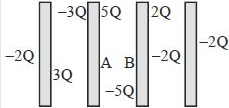

Download our appand get started for free
Experience the future of education. Simply download our apps or reach out to us for more information. Let's shape the future of learning together!No signup needed.*
Similar Questions
- 1Three capacitors, each of $3\,\mu F$, are provided. These cannot be combined to provide the resultant capacitance of.........$\mu F$View Solution
- 2Consider three concentric metallic spheres $A, B$ and $C$ of radii $a , b, c$, respectively where $a < b < c$. $A$ and $B$ are connected, whereas $C$ is grounded. The potential of the middle sphere $B$ is raised to $V$, then the charge on the sphere $C$ isView Solution
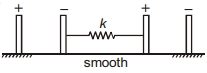
- 3Two charged capacitors have their outer plates fixed and inner plates connected by a spring of force constant ' $k$ '. The charge on each capacitor is q. Find the extension in the spring at equilibriumView Solution
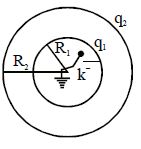
- 4Two concentric spherical shells of radius $R_1$ and $R_2$ have $q_1$ and $q_2$ charge respectively as shown in figure. How much charge will flow through key $k$ when it is closedView Solution
- 5Assume that an electric field $\overrightarrow E = 30{x^2}\hat i$ exists in space. Then the potential difference $V_A -V_O$, where $V_O$ is the potential at the origin and $V_A$ the potential at $x = 2\, m$ isView Solution
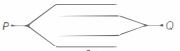
- 6Four metallic plates each of surface area (of one side) $A$, are placed at a distance $d$ apart from each other. The two outer plates are connected to a point $P$ and the two inner plates are connected to another point as shown in figure below. Then, the capacitance of the system isView Solution
- 7An electric dipole has the magnitude of its charge as $q$ and its dipole moment is $p$. It is placed in a uniform electric field $E$. If its dipole moment is along the direction of the field, the force on it and its potential energy are respectivelyView Solution
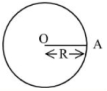
- 8For a uniformly charged thin spherical shell, the electric potential $(V)$ radially away from the center $(O)$ of shell can be graphically represented asView Solution
- 9An infinite number of charges each numerically equal to q and of the same sign are placed along the $x-$ axis at $x = 1,2,4,8.... \,metres$. Then the electric potential at $x = 0$ due to this set of charges isView Solution
- 10As per this diagram a point charge $ + q$ is placed at the origin $O$. Work done in taking another point charge $ - Q$ from the point $A$ [co-ordinates $(0,\,a)$] to another point $B$ [co-ordinates $(a, 0)$] along the straight path $AB$ isView Solution