Question
Wavefront is a locus of points which vibratic in same phase. A ray of light is perpendicular to the wavefront. According to Huygens principle, each point of the wavefront is the source of a secondary disturbance and the wavelets connecting from these points spread out in all directions with the speed of wave.
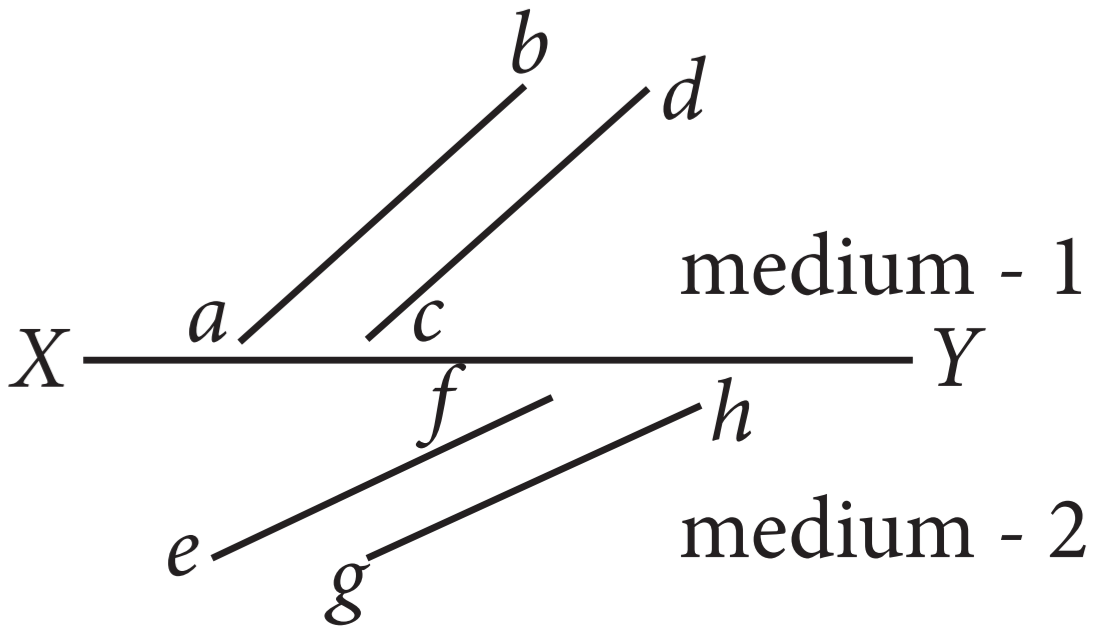
The figure shows a surface XY separating two transparent media, medium-I and medium-2. The lines ab and cd represent wavefronts of a light wave travelling in medium- 1 and incident on XY. The lines ef and gh represent wavefronts of the light wave in medium-2 after refraction.
  1. Light travels as a:
  1. Parallel beam in each medium.
  2. Convergent beam in each medium.
  3. Divergent beam in each medium.
  4. Divergent beam in one medium and convergent beam in the other medium.
  1. The phases of the light wave at c, d, e and f are $\phi_\text{c},\phi_\text{d},\phi_\text{e}$ and $\phi_\text{f}$ respectively. It is given that $\phi_\text{c}\not=\phi_\text{f}$
  1. $\phi_\text{c}$ cannot be equal $\phi_\text{d}$
  2. $\phi_\text{d}$ cannot be equal $\phi_\text{e}$
  3. $(\phi_\text{d}-\phi_\text{f})$ is equal to $(\phi_\text{c}-\phi_\text{e})$
  4. $(\phi_\text{d}-\phi_\text{c})$ is not equal to $(\phi_\text{f}-\phi_\text{e})$
  1. Wavefront is the locus of all points, where the particles of the medium vibrate with the same.
  1. Phase
  2. Amplitude
  3. Frequency
  4. Period
  1. A point source that emits waves uniformly in all directions, produces wavefronts that are:
  1. Spherical
  2. Elliptical
  3. Cylindrical
  4. Planar
  1. What are the types of wavefronts?
  1. Spherical
  2. Cylindrical
  3. Plane
  4. All of these.

Answer

  1. (a) Parallel beam in each medium.
Explanation:
Since the path difference between two waveform is equal, light traves as parallel beam in each medium.
  1. (c) $(\phi_\text{d}-\phi_\text{f})$ is equal to $(\phi_\text{c}-\phi_\text{e})$
Explanation:
Since all points on the wavefront are in the same phase,
$\phi_\text{d}=\phi_\text{c}$ and $\phi_\text{f}=\phi_\text{e}$
$\therefore\phi_\text{d}-\phi_\text{f}=\phi_\text{c}-\phi_\text{e}$
  1. (a) Phase
Explanation:
Wavefront is the locus of all points, where the particles of the medium vibrate with the same phase.
  1. (a) Spherical
  1. (d) All of these.

Need a full question paper?

Generate a complete, print-ready paper with questions like this in minutes — across 16+ boards, with answer keys.

Start Generating Free

Similar questions

When the electron orbiting in hydrogen atom in its ground state moves to the third excited state, show how the de Broglie wavelength associated with it would be affected.
Draw a labelled diagram of an a.c. generator. Obtain the expression for the emf induced in the rotating coil of N turns each of cross-sectional area A in the presence of a magnetic field $\overrightarrow{ B }$.
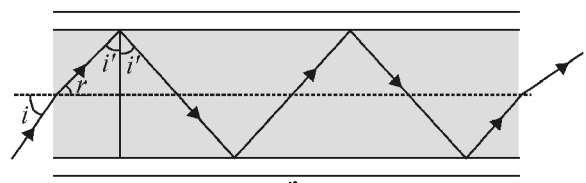
(a) Figure shows a cross-section of a 'light pipe' made of a glass fibre of refractive index 1.68. The outer covering of the pipe is made of a material of refractive index 1.44. What is the range of the angle of the incident rays with the axis of the pipe for which total reflections inside the pipe take place, as shown in the figure. Image
(b) What is the answer if there is no outer covering of the pipe?
When you push your bicycle up on an incline the potential energy of the bicyle and yourself increases. Where does this energy come from?
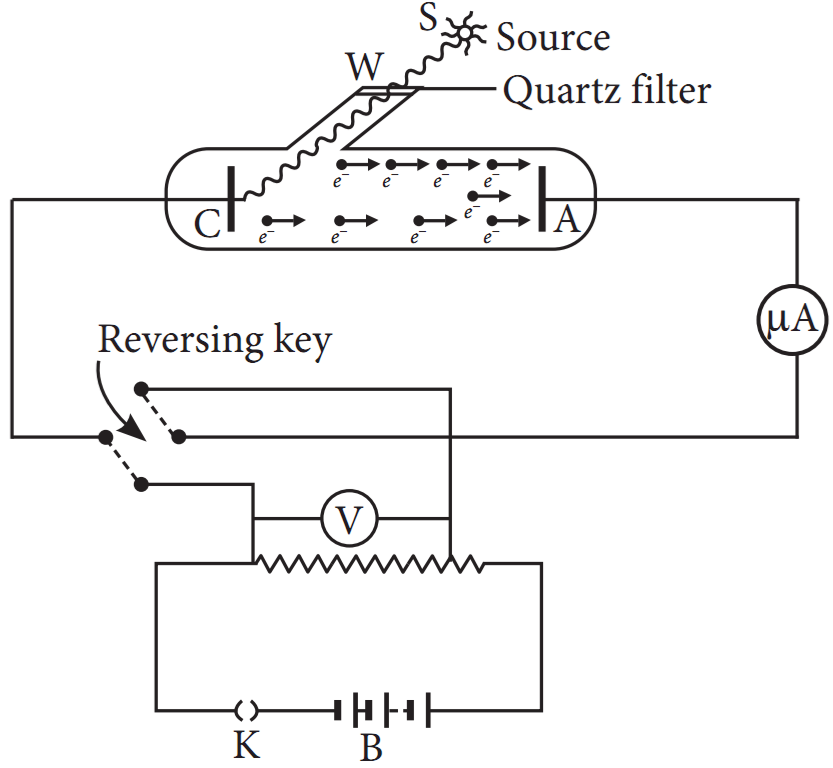
When a monochromatic radiations of suitable frequency obtained from source $S,$ after being filtered by a filter attached on the window $W,$ fall on the photosensitive place $C,$ the photo electrons are emitted from $C,$ which get accelerated towards the plate $A$ if it is kept at positive potential. These electrons flow in the outer circuit resulting in photoelectric current. Due to it, the microammeter shows a deflection. The reading of micrommeter measures the photoelectric current.

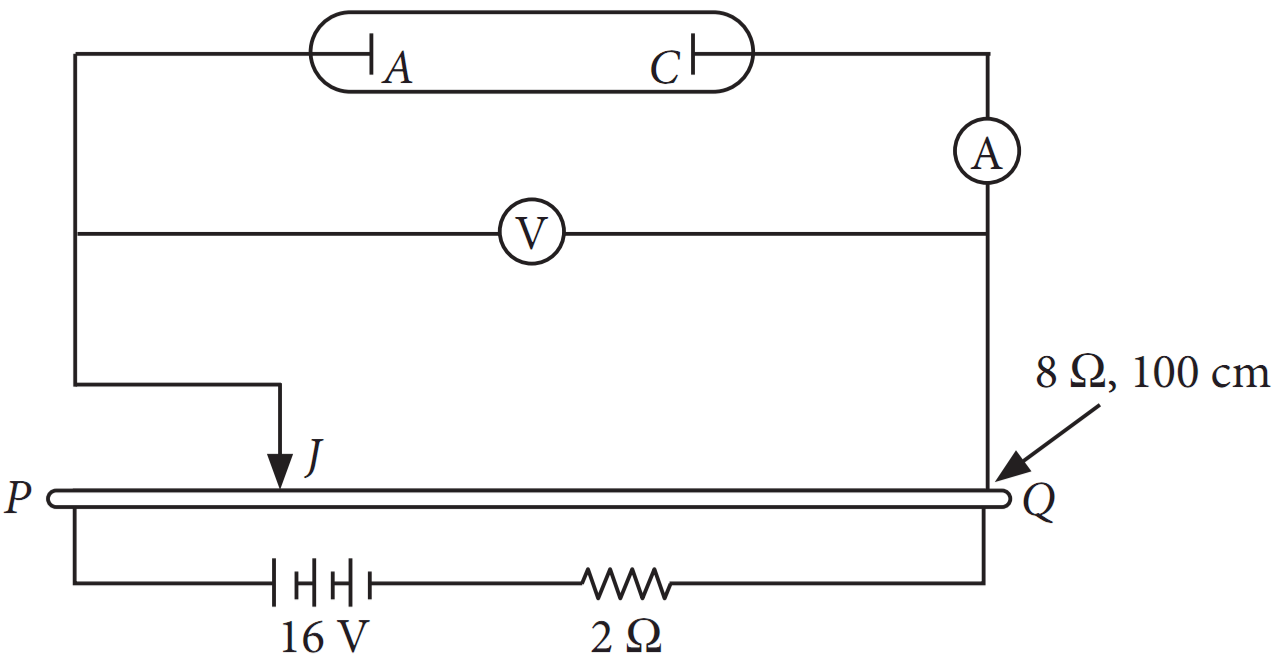
An experimental setup of verification of photoelectric effect is shown in figure. The voltage across the electrodes is measured with the help ofan ideal voltmeter, and which can be varied by moving jockey Jon the potentiometer wire. The battery used in potentiometer circuit is of $16 V$ and its internal resistance is $2\Omega$. The resistance of $100\ cm$ long potentiometer wire is $8\Omega$.

The photocurrent is measured with the help of an ideal ammeter. Two plates of potassium oxide of area $50\ cm^2$ at separation $0.5\ mm$ are used in the vacuum tube. Photocurrent in the circuit is very small, so we can treat the potentiometer circuit as an independent circuit.​​​​​​​
Light
$1$ Violet
$2$ Blue
$3$ Green
$4$ Yellow
$5$ Orange
$6$ Red
$\lambda(\text{in } \mathring{\text{A}})$
$4000-500$ $4500-5000$ $5000-5500$ $5500-6000$ $6000-6500$ $6500-7000$
  1. When radiation falls on the cathode plate, a current of $2\mu\text{A}$ is recorded in the ammeter. Assuming that the vacuum tube setup follows Ohm's law, the equivalent resistance of vacuum tube operating in the case when jockey is at end $P$ is:
  1. $8\times10^8\Omega$
  2. $16\times10^6\Omega$
  3. $8\times10^6\Omega$
  4. $10\times10^6\Omega$
  1. It is found that ammeter current remains unchanged $(2\mu\text{A})$ even when the jockey is moved from the end $P$ to the middle point of the potentiometer wire. Assuming that all the incident photons eject electrons and the power of the light incident is $4\times10^{-6}\Omega$. Then, the color of the incident light is:
  1. Green
  2. Violet
  3. Red
  4. Orange
  1. Which of the following colors may not give photoelectric effect for this cathode?
  1. Green
  2. Violet
  3. Red
  4. Orange
  1. When other light falls on the anode plate, the anuneter reading zero till jockey is moved from the end $P$ to the middle point of the wire $PQ$. Therefore, the deflection is recorded in the anuneter. The maximum kinetic energy of the emitted electron is:
  1. $16eV$
  2. $8eV$
  3. $4eV$
  4. $10eV$
  1. If the intensity of incident radiation is increased twice, the number of photoelectrons emitted per second will be:
  1. Halves
  2. Double
  3. Remain same
  4. Four times
The spectral series of hydrogen atom were accounted for by Bohr using the relation $\text{V}=\text{R}\Bigg(\frac{1}{\text{n}^2_1}-\frac{1}{\text{n}^2_2}\Bigg)$
where $R =$ Rydberg constant $= 1.097 \times 107m^{-1}$ Lyman series is obtained when an electron jumps to first orbit from any subsequent orbit. Similarly, Balmer series is obtained when an electron jumps to $2^{nd}$ orbit from any subsequent orbit, Paschen series is obtained when an electron jumps to $3^{rd}$ orbit from any subsequent orbit. Whereas Lyman series lies in $U.V$. region, Balmer series is in visible region and Pasch en series lies in infrared region. Series limit is obtained when $n_2 = \infty$
  1. The wavelength of first spectral line of Lyman series is.
  1. $1215.4A$
  2. $12154\ cm$
  3. $1215.4m$
  4. $1215.4mm$
  1. The wavelength limit of Lyman series is.
  1. $1215.4A$
  2. $511.9A$
  3. $951.6A$
  4. $911.6A$
  1. The frequency of first spectral line of Bahner series is.
  1. $1.097 \times 10^7Hz$
  2. $4.57 \times 10^{14}Hz$
  3. $4.57 \times 10^{15}Hz$
  4. $4.57 \times 10^{16}Hz$
  1. Which of the following transitions in hydrogen atoms emit photons of highest frequency?
  1. $n = 1$ to $ n = 2$
  2. $n = 2$ to $n = 6$
  3. $n = 6$ to $n = 2$
  4. $n = 2$ to $n = 1$
  1. The ratio of minimum to maximum wavelength in Balmer series is.
  1. $5 : 9$
  2. $5 : 36$
  3. $1 : 4$
  4. $3 : 4$
A horizontal overhead power line carries a current of 90 A in east to west direction. What is the magnitude and direction of magnetic field due to the current 1.5 m in below the line?
Maxwell showed that the speed of an electromagnetic wave depends on the penneability and pennittivity of the medium through which it travels. The speed of an electromagnetic wave in free space is given by $\text{c}=\frac{1}{\sqrt{\mu_0\epsilon_0}}.$ The fact led Maxwell to predict that light is an electromagnetic wave. The emergence of the speed of light from purely electromagnetic considerations is the crowning achievement of Maxwell's electromagnetic theory. The speed of an electromagnetic wave in any medium of permeability $\mu$ and pennittivity $\epsilon$ will be $\frac{\text{c}}{\sqrt{\text{K}\mu_\text{r}}}$ where $K$ is the dielectric constant of the medium and $\mu,$ is the relative permeability.
  1. The dimensions of $\frac{1}{2}\epsilon_0\text{E}^2$ ($\epsilon:$ pennittivity of free space; $E =$ electric field$)$ is:
  1. $MLT^{-1}$
  2. $ML^2T^{-2}$
  3. $ML^{-1}T^{-2}$
  4. $ML^2T^{-1}$
  1. Let $[\epsilon_0]$ denote the dimensional formula of the permittivity of the vacuum. $UM =$ mass, $L =$ length, $T = $ time and $A =$ electric current, then
  1. $[\epsilon_0]=\text{M}^{-1}\text{L}^{-3}\text{T}^2\text{A}$
  2. $[\epsilon_0]=\text{M}^{-1}\text{L}^{-3}\text{T}^4\text{A}^2$
  3. $[\epsilon_0]=\text{MLT}^{-2}\text{A}^{-2}$
  4. $[\epsilon_0]=\text{ML}^{2}\text{A}^{-1}$
  1. An electromagnetic wave offrequency $\text{3MHz}$ passes from vacuum into adielectricmedium with permittivity $\epsilon=4.$ Then
  1. Wavelength and frequency both remain unchanged.
  2. Wavelength is doubled and the frequency remains unchanged.
  3. Wavelength is doubled and the frequency becomes half.
  4. Wavelength is halved and the frequency remains unchanged.
  1. Which of the following are not electromagnetic waves?
  1. Cosmic rays
  2. $\gamma-\text{rays}$
  3. $\beta-\text{rays}$
  4. $X-$rays
  1. The electromagnetic waves travel with,
  1. The same speed in all media.
  2. The speed oflight $c = 3 \times 10^8ms^{-1}$ in free space.
  3. The speed oflight $c = 3 \times 10^8ms^{-1}$ in solid medium
  4. The speed of light $c = 3 \times 10^8ms^{-1}$ in fluid medium.
Ram is a  student of class X in a village school. His uncle gifted him a bicycle with a dynamo fitted in it. He was very excited to get it. While cycling during night, he could light the bulb and see the objects on the road. He however, did not know this device works. He asked this question to his teacher. the teacher considered it an opportunity to explain the working to the whole class.
Answer the following question:
  1. State the principle and working of a dynamo.
  2. Write two values each displayed by Ram and his school teacher.