MCQ
Wavefront means
  • All particles in it have same phase
  • B
    All particles have opposite phase of vibrations
  • C
    Few particles are in same phase, rest are in opposite phase
  • D
    None of these

Answer

Correct option: A.
All particles in it have same phase
a
(a)Wavefront is the locus of all the particles which vibrates in the same phase.

Need a full question paper?

Generate a complete, print-ready paper with questions like this in minutes — across 16+ boards, with answer keys.
Start Generating Free

Similar questions

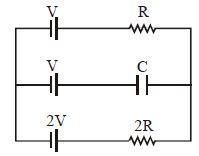
In the given circuit, with steady current, the potential drop across the capacitor must be
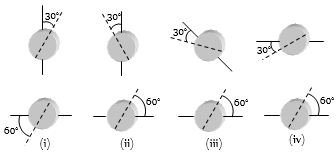
The figure shows four pairs of polarizing sheets, seen face-on. Each pair is mounted in the path of initially unpolarized light. The polarizing direction of each sheet (indicated by the dashed line) is referenced to either a horizontal $x$ - axis or $a$ vertical $y$ axis. Rank the pair according to the fraction of the initial intensity that they pass, greatest first
Given a thin convex lens (refractive index $\mu_2$ ), kept in a liquid (refractive index $\mu_1, \mu_1<\mu_2$ ) having radii of curvature $\left|R_1\right|$ and $\left|R_2\right|$. Its second surface is silver polished. Where should an object be placed on the optic axis so that a real and inverted image is formed at the same place?
The frequency and the intensity of a beam of light falling on the surface of photoelectric material are increased by a factor of two. This will :
A simple pendulum consisting of a ball of mass $m$ tied to a thread of length $l$ is made to swing on a circular arc of angle $\theta $ in a vertical plane. At the end of this arc, another ball of mass $m$ is placed at rest. The momentum transferred to this ball at rest by the swinging ball is
An electric dipole of moment $p$ is placed at the origin along the $x$-axis. The electric field at a point $P$, whose position vector makes an angle $\theta $ with the $x$-axis, will make an angle ..... with the $x$-axis, where $\tan \alpha = \frac{1}{2}\tan \theta $
A spherical body of mass $100 g$ is dropped from a height of $10 m$ from the ground. After hitting the ground, the body rebounds to a height of $5m$. The impulse of force imparted by the ground to the body is given by : $\left(\right.$ given $\left.g =9.8 m / s ^2\right)$
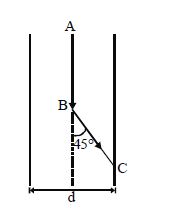
A sphere carrying charge of $Q$ having weight $w$ falls under gravity between a pair of vertical plates at a distance of $d$ from each other. When a potential difference $V$ is applied between the plates the acceleration of sphere changes as shown in the figure, to along line $BC$. The value of $Q$ is :-
A conducting sphere of radius $r$ has a charge. Then
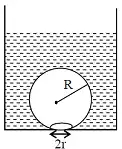
On heating water, bubbles being formed at the bottom of the vessel detach and rise. Take the bubbles to be spheres of radius $R$ and making a circular contact of radius $r$ with the bottom of the vessel. If $r < < R$, and the surface tension of water is $T$, value of $r$ just before bubbles detach is (density of water is $\rho_{w}$)