MCQ
Wavefront of a wave has direction with wave motion:
- AParallel
- BPerpendicular
- COpposite
- DAt an angle of $\theta$
Explanation:
Direction of wave is perpendicular to the wavefront.
Generate a complete, print-ready paper with questions like this in minutes — across 16+ boards, with answer keys.
When a wire loop is rotated in a magnetic field, the direction of induced e.m.f. changes once in each
|
(a) |
(b) |
(c) 1 revolution |
(d) 2 revolution |
A small bar magnet A oscillates in a horizontal plane with a period T at a place where the angle of dip is 60o. When the same needle is made to oscillate in a vertical plane coinciding with the magnetic meridian, its period will be
(a) 
|
(b) T |
(c) 
|
(d) 2T |
The current flowing in a copper voltameter is 3.2 A. The number of copper ions ( deposited at the cathode per minute is
|
(a) 0.5 |
(b) 1.5 |
(c) 3 |
(d) 6 |
Electromagnetic waves are transverse in nature is evident by
|
(a) Polarization |
(b) Interference |
(c) Reflection |
(d) Diffraction |
The electric flux for Gaussian surface A that enclose the charged particles in free space is (given q1 = –14 nC, q2 = 78.85 nC, q3 = – 56 nC)
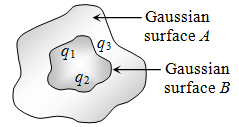
|
(a) 103 Nm2 C–1 |
(b) 103 CN-1 m–2 |
(c) 6.32 × 10³ Nm2 C–1 |
(d) 6.32 × 10³ CN-1 m–2 |
Which statement is correct
|
(a) N-type germanium is negatively charged and P-type germanium is positively charged |
|
(b) Both N-type and P-type germanium are neutral |
|
(c) N-type germanium is positively charged and P-type germanium is negatively charged |
|
(d) Both N-type and P-type germanium are negatively charged |
When there is an electric current through a conducting wire along its length, then an electric field must exist
|
(a) Outside the wire but normal to it |
(b) Outside the wire but parallel to it |
|
(c) Inside the wire but parallel to it |
(d) Inside the wire but normal to it |


