Question

When there is an electric current through a conducting wire along its length, then an electric field must exist

(a)  Outside the wire but normal to it

(b) Outside the wire but parallel to it

(c) Inside the wire but parallel to it

(d) Inside the wire but normal to it

Answer

(c) Inside the wire but parallel to it

Need a full question paper?

Generate a complete, print-ready paper with questions like this in minutes — across 16+ boards, with answer keys.

Start Generating Free

Similar questions

There is a solid sphere of radius ‘R’ having uniformly distributed charge. What is the relation between electric field ‘E’ (inside the sphere) and radius of sphere ‘R’ is

(a) E  

(b) E

(c) E     

(d) E

A hollow sphere and a solid sphere having same mass and same radii are rolled down a rough inclined plane:
  1. The hollow sphere reaches the bottom first.
  2. The solid sphere reaches the bottom with greater speed.
  3. The solid sphere reaches the bottom with greater kinetic energy.
  4. The two spheres will reach the bottom with same linear momentum.
Lenz's law is a direct consequence of:

A nucleus decays by  emission followed by a gamma emission. If the atomic and mass numbers of the parent nucleus are Z and A respectively, the corresponding numbers for the daughter nucleus are respectively.

(a) Z  - 1 and A - 1  

(b) Z + 1 and A

(c) Z - 1  and A

(d) Z + 1 and A - 1

Which of the following is wrong statement

(a) An emf can be induced between the ends of a straight conductor by moving it through a uniform magnetic field

(b) The self induced emf produced by changing current in a coil always tends to decrease the current

(c) Inserting an iron core in a coil increases its coefficient of self induction

(d) According to Lenz's law, the direction of the induced current is such that it opposes the flux change that causes it

A current passes through a resistor. Let K1 and K2 represent the average kinetic energy of the conduction electrons and the metal ions, respectively:
  1. K2 < K2
  2. K1 = K2
  3. K1 > K2
  4. Any of these three may occur.

Which of the following statement is correct

(a) Both Peltier and Joule effects are reversible

(b) Both Peltier and Joule effects are irreversible

(c) Joule effect is reversible, whereas Peltier effect is irreversible

(d) Joule effect is irreversible, whereas Peltier effect is reversible

The figure shows a circuit diagram of a ‘Wheatstone Bridge’ to measure the resistance G of the galvanometer. The relation   will be satisfied only when

(a) The galvanometer shows a deflection when switch S is closed

(b) The galvanometer shows a deflection when switch S is open

(c) The galvanometer shows no change in deflection whether S is open or closed

(d) The galvanometer shows no deflection

When two deuterium nuclei fuse together to form a tritium nuclei, we get a

(a) Neutron

(b) Deutron

(c) α - particle

(d) Proton

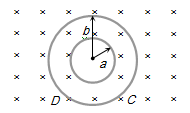
Plane figures made of thin wires of resistance R = 50 milli ohm/metre are located in a uniform magnetic field perpendicular into the plane of the figures and which decrease at the rate dB/dt = 0.1 m T/s. Then currents in the inner and outer boundary are. (The inner radius a = 10 cm and outer radius b = 20 cm)

(a) 10– 4 A (Clockwise), 2 × 10– 4 A (Clockwise)

(b) 10– 4 A (Anticlockwise), 2 × 10– 4 A (Clockwise)

(c) 2 × 10– 4 A (clockwise), 10– 4 A (Anticlockwise)

(d) 2 × 10– 4 A (Anticlockwise), 10– 4 A (Anticlockwise)